Stand with Ukraine flag
Pricing Try it now
Edge
Getting Started Documentation Installation Architecture API

Frequently Asked Questions

Edge Computing - Community Edition

General Questions
Edition Comparison & Upgrade
Features & Capabilities
Installation & Setup
Support
What is ThingsBoard Edge Community Edition?

ThingsBoard Edge Community Edition (CE) is a free, open-source platform designed specifically for edge computing scenarios. It provides essential capabilities for managing and analyzing IoT data at the edge, while staying seamlessly synchronized with the ThingsBoard Server (Cloud or On-premise).

New to edge computing? Edge computing means processing data where it's generated rather than sending everything to the cloud.

See What is Edge? for a detailed introduction, or jump to our Getting Started to begin working with ThingsBoard Edge.

I can deploy Server on-site. Why should I deploy Edge instead?

If you only have one site, deploying ThingsBoard Server on-premises may be enough.

Use ThingsBoard Edge when you have multiple or remote locations that need local processing, dashboards, and automation, but you don't want a full Server at each site.

Server stays your central hub, while Edge runs on lightweight hardware at each site and keeps working offline, then syncs data and configuration back to Server.

How do I get ThingsBoard Edge Community Edition?

Edge Community Edition is open-source and free to download. Install it from our documentation or access the source code on GitHub.

You'll need a ThingsBoard Server instance to connect Edge to. See our Getting Started guide for complete setup instructions.

Can I run ThingsBoard Edge on Raspberry Pi or other edge devices?

Yes, ThingsBoard Edge is specifically designed to run on a variety of Edge hardware platforms, including single-board computers like Raspberry Pi and other devices with sufficient processing power and memory.

What happens if my internet connection drops?

Edge keeps running. It processes data, triggers alarms, and updates dashboards locally — no cloud required. When connectivity returns, Edge automatically syncs everything with your ThingsBoard Server. No data loss, no manual intervention.

Can Edge handle my device volume?

We recommend up to 1,000 devices per Edge instance based on typical edge hardware and connectivity constraints. You can exceed this number; performance depends on your specific hardware and network conditions.

If you need more capacity, you can deploy multiple Edge instances. Alternatively, if you are using version 4.0 or later, you can cluster Edge nodes for high availability.

I have devices that use proprietary protocols. Can Edge connect to them?

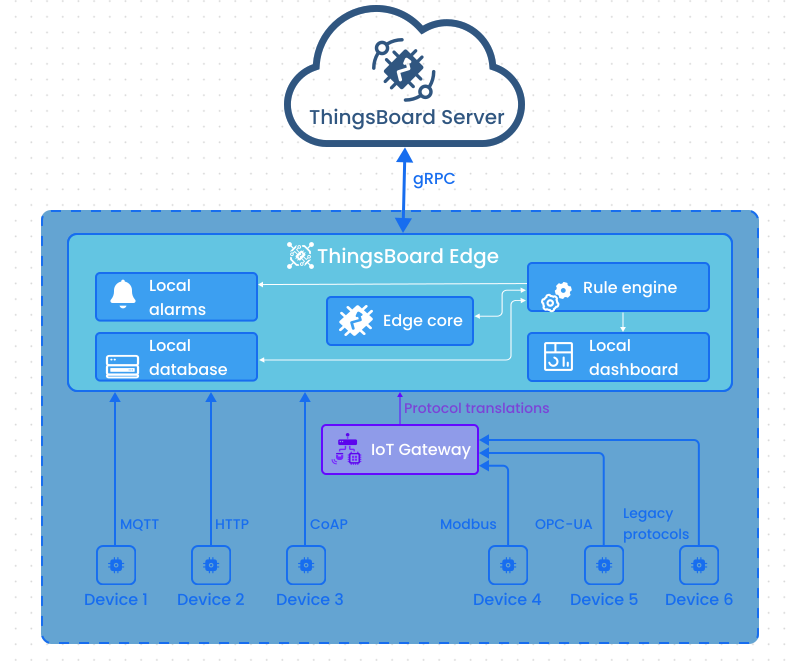
Yes. Edge natively supports MQTT, CoAP, HTTP, SNMP, and LwM2M. For other protocols, use:

For other protocols, use the ThingsBoard IoT Gateway to bridge legacy devices. Gateway supports Modbus, BACnet, OPC-UA, and more, and is available at no extra cost.

Can I customize and modify the Edge Community Edition?

Yes, the source code is available on GitHub, and you can fork and modify it to suit your needs. By the way, please consider starring our repository.

Load more FAQ
What's the difference between Edge Community Edition and Professional Edition?

Both editions provide device management, rule engine, dashboards, and standard protocols (MQTT, CoAP, HTTP, etc.).

Community Edition is free and open-source.

Professional Edition is commercial and adds:

  • White-labeling: Deploy under your company's brand.
  • Solution templates: Pre-built IoT solutions ready to install with dashboards, rule chains, and sample devices.
  • Converter library: Ready-to-use decoder functions for 100+ devices across 6 LoRaWAN networks.
  • Scheduler: Automate report generation, attribute updates, and device commands.
Do I need PE Edge if I'm building a commercial product?

Not necessarily. Community Edition is production-ready and supports commercial deployments. You can build, sell, and deploy commercial products on CE.

The choice between CE and PE depends on your specific requirements.

Consider PE if you need to:

  • Deliver a branded product to customers.
  • Connect legacy equipment via OPC-UA or other industrial protocols.
  • Deploy pre-built solutions (irrigation, water metering, waste management, etc.).
  • Manage multiple end-customers with hierarchical access control.
Can I use Edge Professional Edition with Community Edition Server and vise versa?

No. Edge edition must match your ThingsBoard Server edition:

  • CE Edge connects to ThingsBoard CE Server.
  • PE Edge connects to ThingsBoard PE Server.

PE-specific features (white-labeling, solution templates, integrations, etc.) require both PE Edge and PE Server to function.

How many Edge instances can connect to one Server?
  • CE Edge: The number of Edge instances is unlimited.
  • PE Edge: The number of included Edge instances depends on your ThingsBoard PE plan. You can add extra Edge instances for an additional monthly cost. Check your plan details or contact your administrator to see how many Edge instances are included.
Can I migrate from CE Edge to PE Edge?

Yes, but it requires upgrading your entire system:

  • Upgrade your ThingsBoard Server from CE to PE.
  • Purchase the Edge Computing add-on for your PE license.
  • Reinstall Edge using PE packages.

Before upgrading: Back up any custom dashboards, rule chains, or configurations. Consult our support team for assistance or see our migration guide for step-by-step instructions.

How do I start a free trial?

Community Edition is free and open-source - no trial needed. Download and use it indefinitely at no cost.

For Professional Edition, you can start with the Free plan, which is limited in terms of the number of devices, but which has Edge Computing add-on permanently enabled. This allows you to try out the add-on features free of charge.

What core features are available in the Community Edition?

Edge Community Edition provides complete edge computing functionality:

  • Device connectivity: MQTT, CoAP, HTTP, SNMP, and LwM2M protocols.
  • Local data processing: Rule engine for real-time analytics and automation.
  • Visualization: Dashboard creation and customization.
  • Data management: Device telemetry collection and attribute management.
  • Open-source: Fully open-source with active community support.
Does the ThingsBoard Edge support multi-tenancy?

No, ThingsBoard Edge Community Edition does not support multi-tenancy.

Community Edition is designed for a single tenant and a single customer. This means that you can not share a single Edge instance between multiple tenants or customers, as well as devices from different tenants can not be connected to the same Edge instance.

If you need multi-tenancy, provision multiple Edge instances for each tenant.

Does ThingsBoard Edge Community Edition support AI or machine learning integrations?

Yes. Edge includes an AI Request node in the Rule Engine that allows integration with AI services like OpenAI, Azure OpenAI, and custom AI endpoints. You can use this for predictive maintenance, anomaly detection, natural language processing, and other AI-powered analytics.

See AI predictive maintenance example for implementation details.

Can I integrate devices that are connected via third-party systems such as LoRAWAN?

Not out-of-the-box for Community Edition. To connect with third-party platforms like LoRaWAN networks, you would need to develop custom integration code.

Professional Edition provides ready-to-use Platform Integrations for LoRaWAN networks (ChirpStack, TTN, Loriot), OPC-UA servers, and 30+ other platforms. See Edge Integrations documentation for more details.

Does ThingsBoard Edge support clustering?

Starting with version 4.0, yes. You can cluster multiple Edge nodes for high availability. If one node fails, others continue handling workloads.

Earlier versions run as single instances.

Refer to Edge Cluster Setup documentation for more details.

What databases and uplink message storages does ThingsBoard Edge support?

Edge Community Edition supports pure SQL and hybrid SQL + NoSQL (for telemetry storage) approaches:

  • PostgreSQL: The default; suitable for most deployments.
  • PostgreSQL + Cassandra: A hybrid approach for high-volume telemetry (1M+ devices or >5,000 msg/sec).

Edge also supports different uplink message storages:

  • PostgreSQL: The built-in default, suitable for PoC and low-load environments — not recommended for production or cluster deployments with high volumes of uplink messages.
  • Kafka: Recommended for production deployments.
Does Edge Community Edition support UI customization options, such as white-labeling or custom menu?

White-labeling and custom menu configuration are Professional Edition features that provide UI customization without code changes.

Community Edition is open-source, allowing developers to customize the interface by modifying the source code.

Can I automate device management and telemetry processing?

Yes. you can. The Rule Engine allows you to automate device workflows, data processing, and alerts based on incoming telemetry.

For example, you can automatically provision devices, transform data, trigger actions based on thresholds, or forward telemetry to external systems.

Can I run rule chains on Edge?

Yes. Edge runs rule chains locally for real-time processing. Starting with version 4.0, you can create and edit rule chains directly on Edge. In earlier versions, rule chains are configured as templates on the Server and pushed to Edge.

See Edge Rule Chain Templates for more information.

Does Edge Community Edition support OTA (Over-the-Air) firmware updates?

Yes. You can manage firmware versions, schedule updates, and track deployment status across your devices. See OTA updates documentation for setup instructions.

Is there a mobile app for ThingsBoard Edge Community Edition?

No, there is no dedicated mobile app for ThingsBoard Edge.

However, you can access and manage Edge instance through a web browser on any device, including mobile devices. Typically, instance is hosted on port 8080.

Load more FAQ
Is Edge version tied to Server version?

Partially. Edge version X.Y.Z works with:

  • Server version X.Y.Z (same version).
  • Server versions X.Y+1 and X.Y+2 (up to two minor versions ahead).

Edge does not work with older Server versions.

Example: Edge 3.8.0 works with Server 3.8.0, 3.8.1, and 3.9.0 — but not with Server 3.7.x or earlier. If your Edge is newer than your Server, upgrade the Server first.

See also Edge Release Notes.

What hardware do I need to run Edge?

Less than you might think. Edge runs on:

  • Raspberry Pi or similar single-board computers.
  • Industrial gateways.
  • Mini PCs or embedded systems.
  • Any machine with 1GB+ RAM for light workloads, 4GB+ for heavy use.
How to upgrade to the latest version?

To upgrade to the latest version, follow upgrade instructions.

How can I connect my device?

ThingsBoard Edge supports various protocols, including MQTT, CoAP, HTTP, and LwM2M.

Legacy devices can be connected to the platform via ThingsBoard Gateway. More information is available on the connectivity page.

How do I install Edge?

Edge runs on Docker, Ubuntu, CentOS, Windows, and Raspberry Pi. See the Installation Guide for step-by-step instructions.

See the Installation Options for step-by-step instructions.

Is there an official Docker image for ThingsBoard Edge?

Yes, the official Docker image is available on Docker Hub.

Where does ThingsBoard Edge store time-series data?

By default, Edge stores time-series data in PostgreSQL, which handles both device metadata and telemetry efficiently for typical deployments.

For high-volume scenarios (1M+ devices or >5,000 msg/sec), you can configure a hybrid setup where time-series data is stored in Cassandra while PostgreSQL handles device metadata and attributes.

Do I need to use a software development kit (SDK)?

No, many IoT devices are not designed to embed third-party SDKs.

ThingsBoard Edge provides a simple API over common IoT protocols, so you can choose any client-side library you like, or even use your own. Some useful references include MQTT client-side libraries list and C-implementation for CoAP.

Load more FAQ
What support options are available for the Community Edition?

Support for the Community Edition is primarily community-driven, including:

What should I do if I find a bug in Community Edition?

You can report it on GitHub Issues, and the open-source community may help fix it.

Can I contribute to the development of ThingsBoard Edge Community Edition?

Yes! Pull requests and contributions are welcome on GitHub. By the way, please consider starring our repository.

Is official support available for the Community Edition?

No, official support is not included in the Community Edition. For official support, consider upgrading to a paid edition.