Grain silo monitoring
Watch grain temperature, humidity, and crop levels in every silo on one dashboard, with a night mode for late shifts.
See smart farming templatesWe use cookies
We use cookies for site analytics, to measure our advertising campaigns and, if you allow it, to load the site search from Google. Nothing optional is set until you choose. You can change your choice anytime in Your Privacy Choices at the bottom of every page. Cookie Policy
IoT in agriculture means fewer trips to the field and fewer surprises in storage. Sensors in silos, greenhouses, and fields report temperature, humidity, soil moisture, and crop levels to ThingsBoard, which turns them into live dashboards and alarms your team can act on.
The live demo shows grain storage: three silos with temperature, humidity, and crop levels, plus a night mode for late shifts. Alarm rules warn your team before grain starts to spoil, and rules can switch on aeration automatically.
The same smart farming IoT platform covers greenhouses, irrigation, livestock, and farm equipment, so you can add new sites and devices as the project grows.
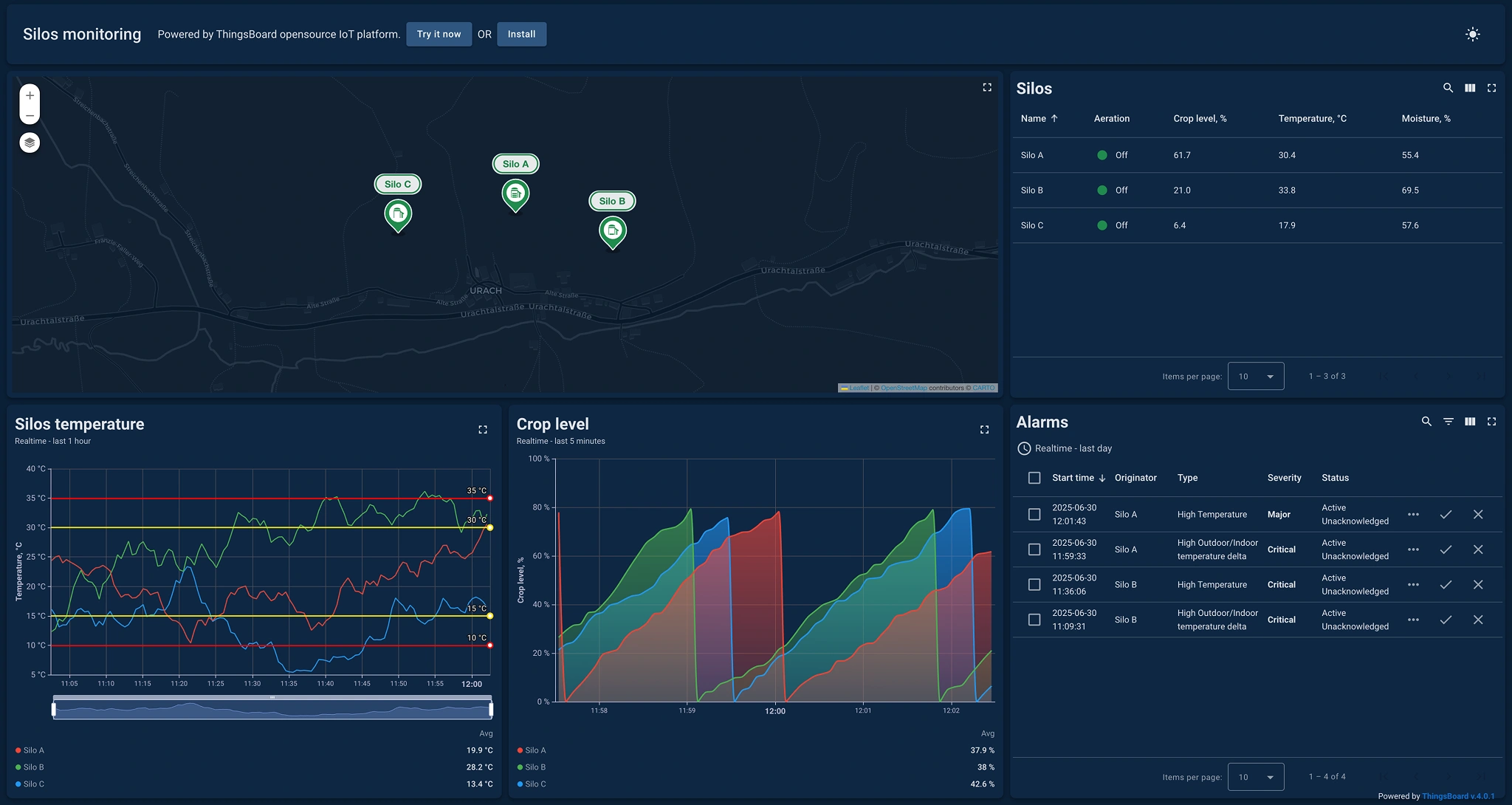
Smart farming dashboard in dark mode: a map of three silos, their crop level, temperature, and moisture, and active alarms
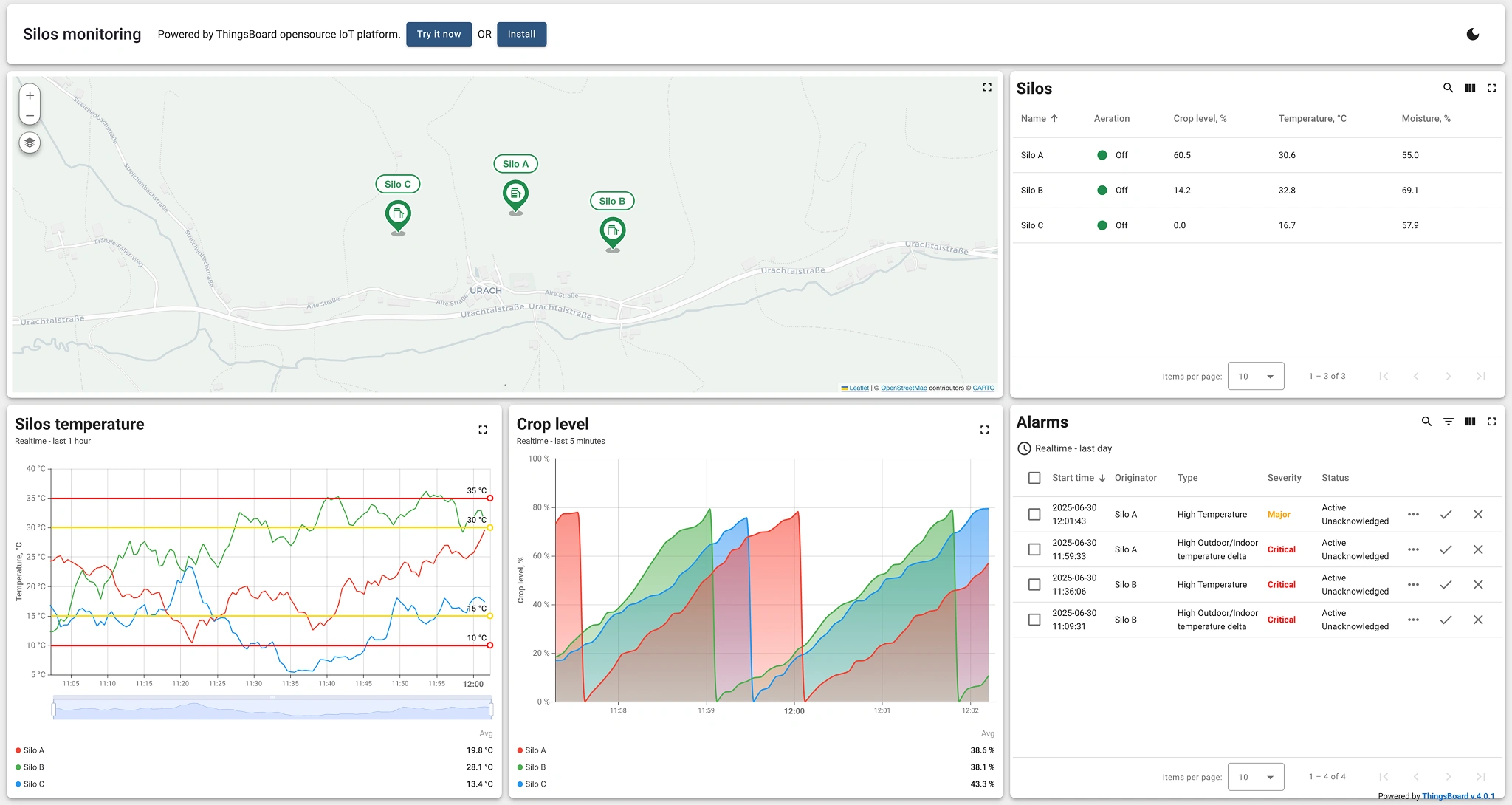
Smart farming dashboard in light mode: the same map of three silos, their crop level, temperature, and moisture, and active alarms
Smart farming dashboard in dark mode: a map of three silos, their crop level, temperature, and moisture, and active alarms
Smart farming dashboard in light mode: the same map of three silos, their crop level, temperature, and moisture, and active alarms

The smart farming solution connects IoT sensors across silos, greenhouses, and fields to collect temperature, humidity, soil moisture, and crop levels. Sensors connect directly over MQTT, HTTP, or CoAP, existing equipment that uses Modbus or OPC UA connects through the IoT Gateway, and battery-powered field sensors come in from LoRaWAN or NB-IoT networks.
ThingsBoard processes incoming telemetry with rule chains that trigger alerts or control actions. Dashboards show the data on maps and charts, so your team can spot issues and respond quickly. The same setup works for a small farm and for a large agricultural enterprise.
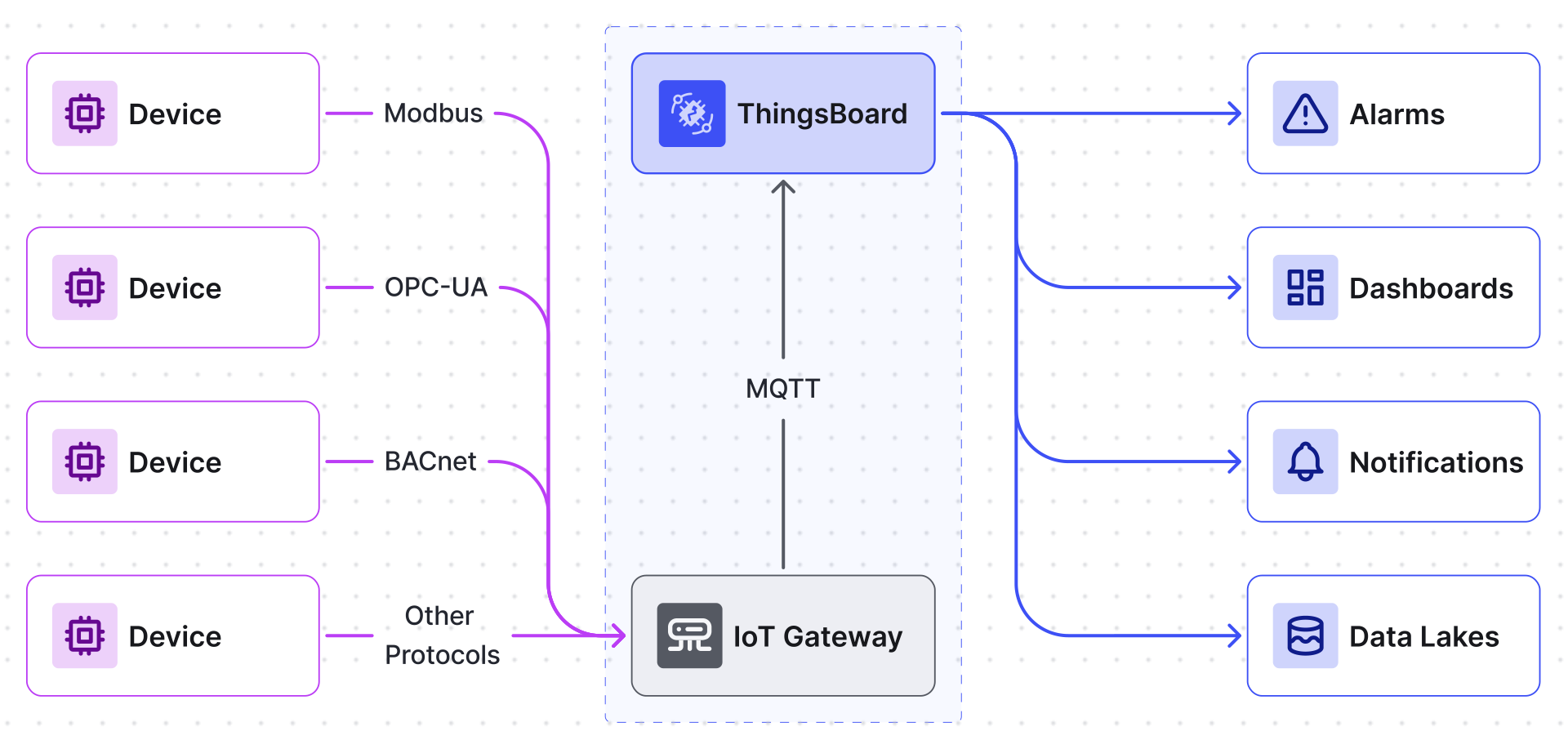
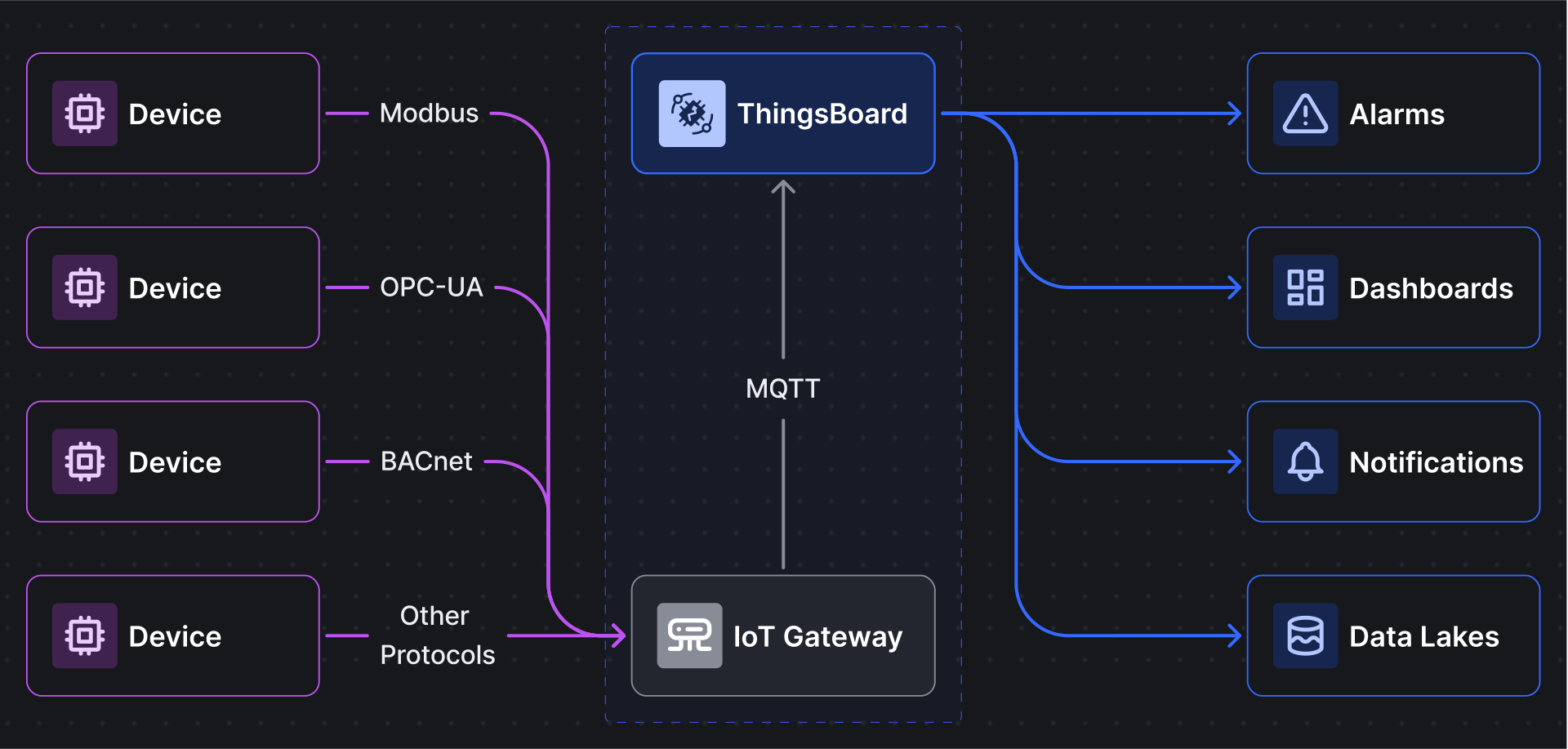
One dashboard for every silo and field: a map with locations, live readings, charts, and alarms, with a detailed view for each silo.
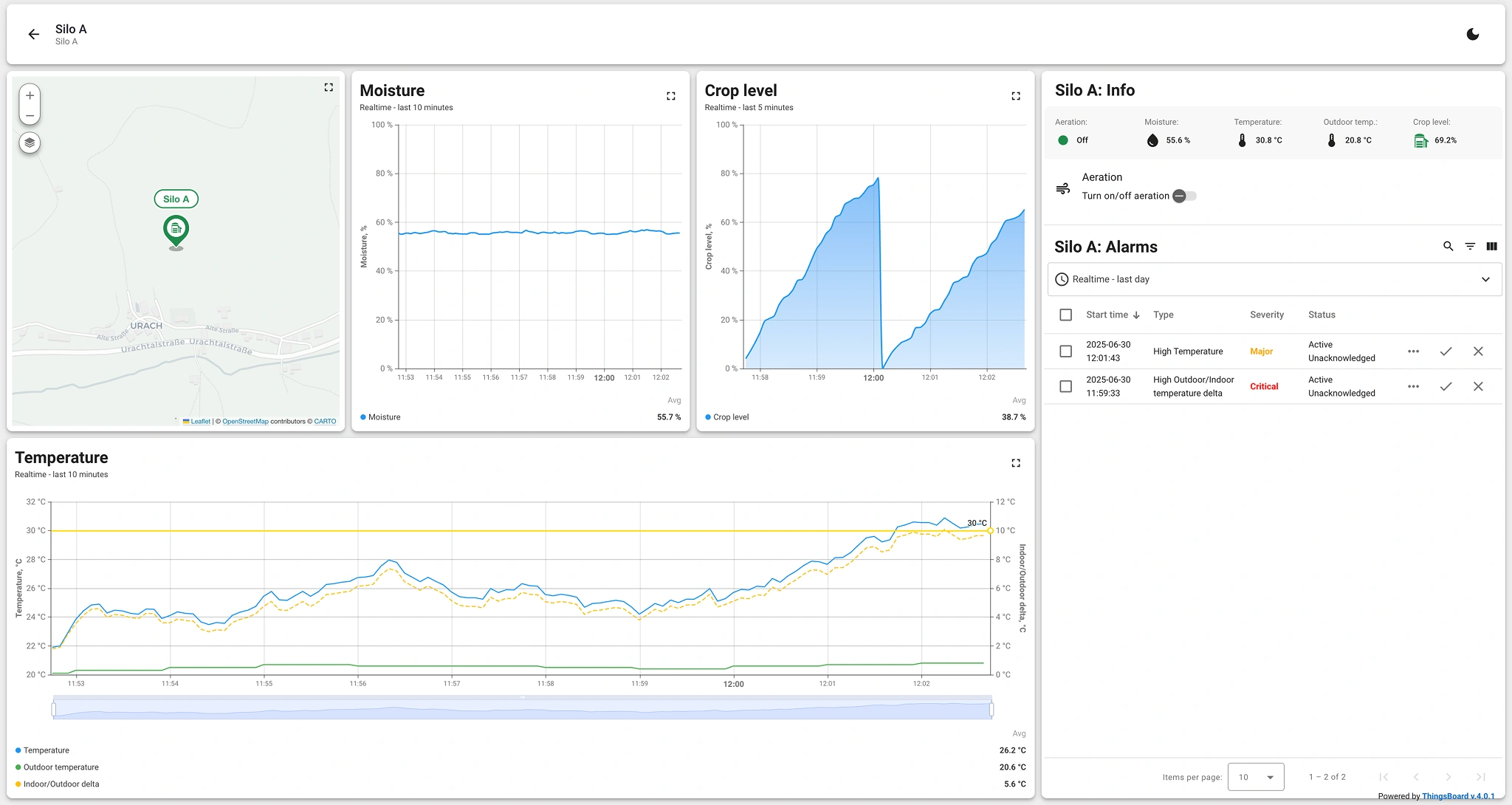
Displays a geographic map with locations, real-time stats (aeration, crop level, temperature, humidity), charts for crop level and temperature, and an alarm panel. Consolidates multiple data points for instant status tracking and efficient response.
A dark version of the main dashboard for night shifts and low-light rooms, so operators can focus on the data.
Features local map, moisture graph, crop level chart, temperature trends, and aeration control toggle. Focused monitoring supports precise diagnostics and device-level control.
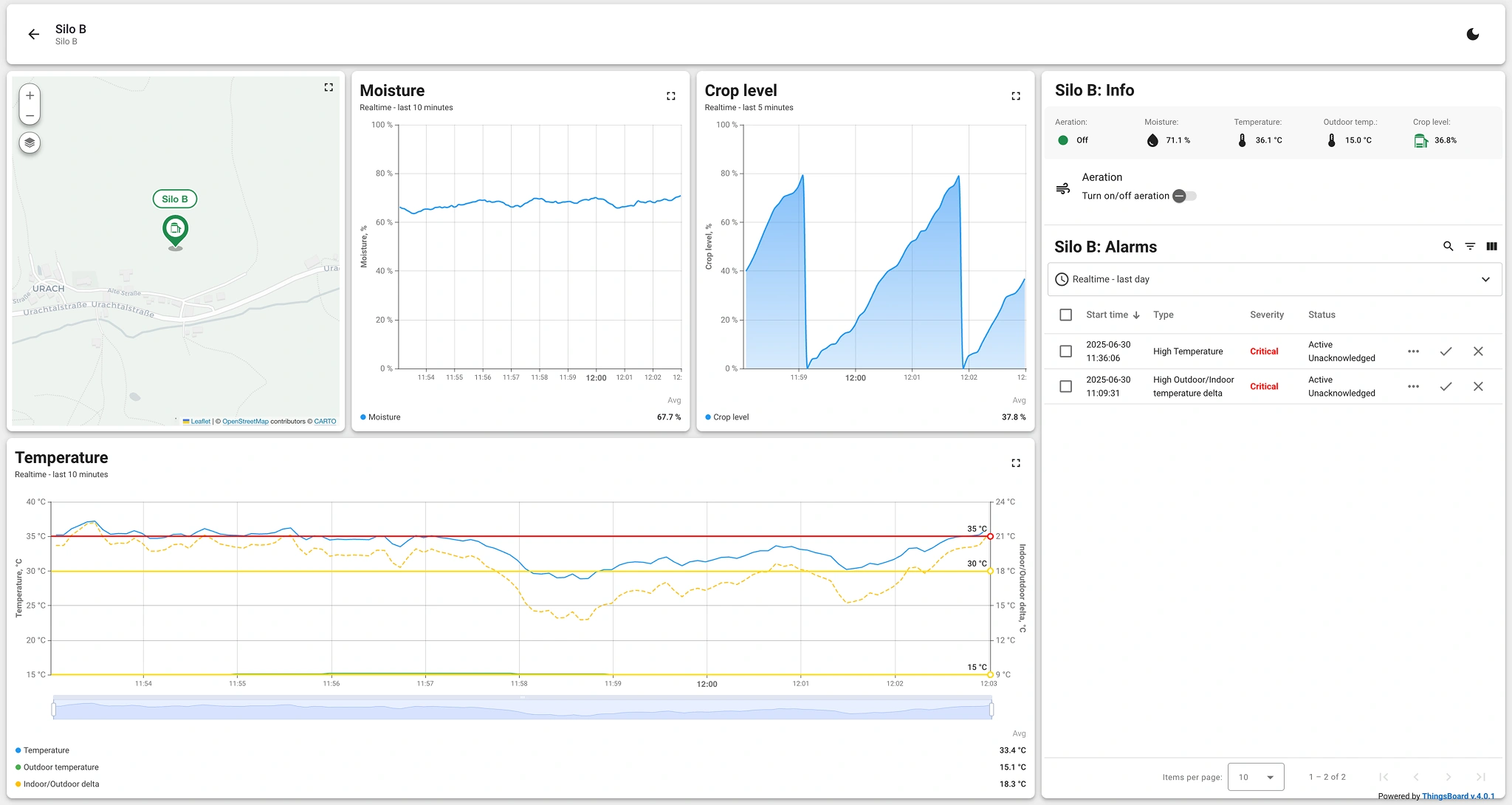
Similar layout, highlighting real-time moisture, crop level, indoor/outdoor temperature comparison. Enables insights into environmental conditions and ventilation efficiency.
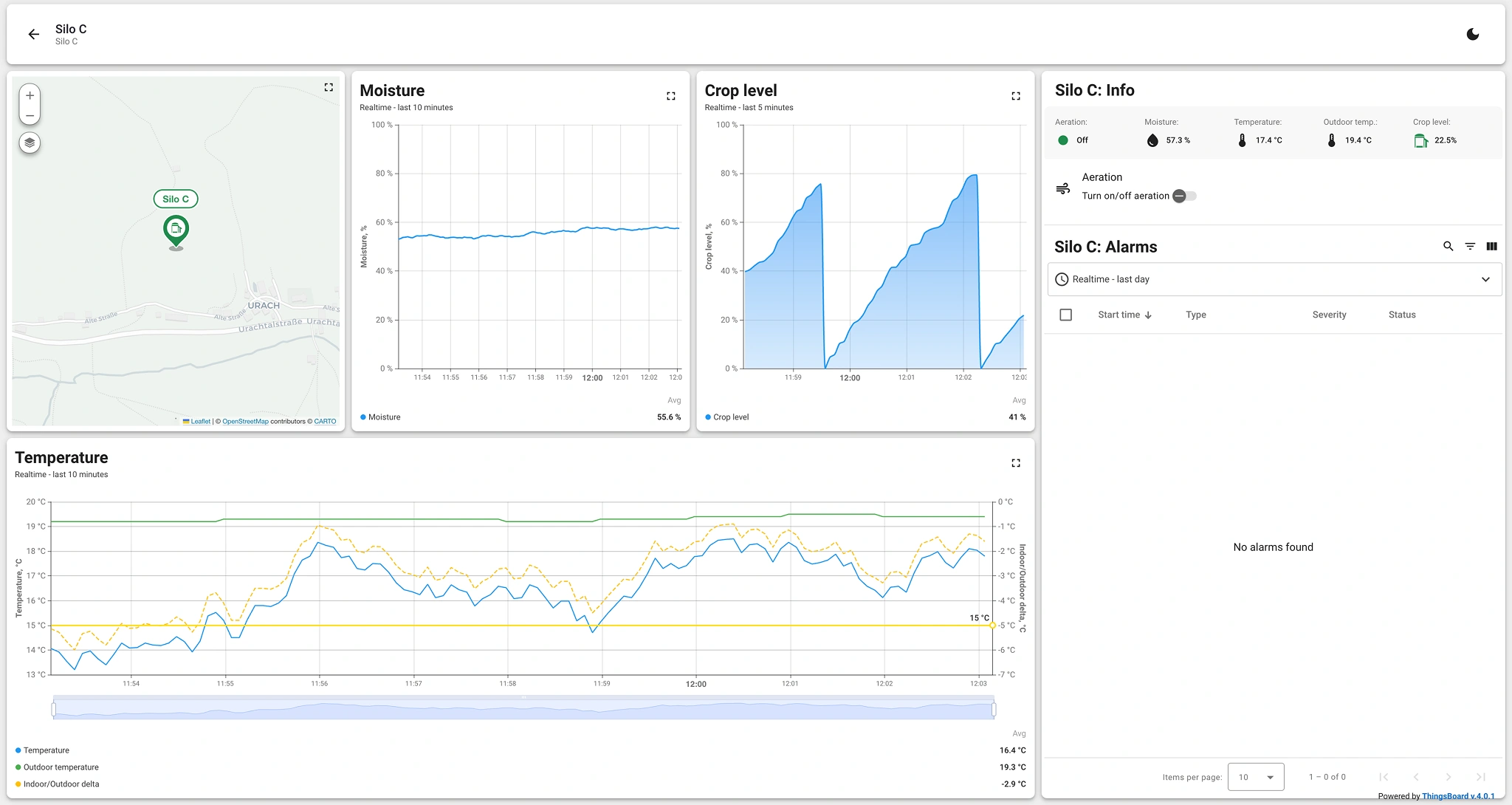
Displays readings from a silo with aeration turned off, helping to assess impact on crop conditions. Supports preventive maintenance and smarter control strategies.
The same approach works across farming and related sectors.
Monitor temperature, humidity, and gas levels in storage facilities to prevent spoilage and automate ventilation.
Automated climate control in greenhouses using real-time sensor data to regulate temperature, humidity, CO₂, and lighting for year-round optimal growing conditions.
Monitoring animal health, barn climate conditions, and feed levels in real time. Automated alerts for abnormal behavior or environmental changes help prevent losses and improve animal welfare.



Track microclimate data across vineyards and orchards to optimize irrigation, frost protection, and harvest timing.
Monitor agricultural products during transport and storage for temperature compliance and farm-to-market traceability.
The most common uses are monitoring grain and produce in storage, controlling greenhouse climate, watering fields based on soil moisture, and tracking livestock and equipment. In each case, sensors send readings to a platform like ThingsBoard, which stores the data, raises alarms, and shows it on dashboards. For watering, see smart irrigation.
Typical sensors measure temperature, humidity, soil moisture, and grain or liquid levels. They connect directly over MQTT, HTTP, or CoAP, through the ThingsBoard IoT Gateway for industrial protocols such as Modbus and OPC UA, from a LoRaWAN or NB-IoT network, or via a platform integration. You can pick pre-integrated devices in the IoT Hub and use emulators while the hardware isn’t ready. Details are in the connectivity guide.
Yes. Battery-powered sensors on LoRaWAN or NB-IoT networks send data over long distances, so you can cover remote fields and storage sites. ThingsBoard receives the data from the network server through a platform integration.
Yes. Our team builds custom solutions on ThingsBoard, from a proof of concept to production. Agricultural companies such as Supertech Agroline and Keners run their farming platforms on ThingsBoard. Tell us about your sites and devices through the contact form.
Smart farming with ThingsBoard offers a complete end-to-end IoT solution for agricultural operations. From field to storage, it unifies device connectivity, real-time analytics, control systems, and user-friendly dashboards. By adopting this solution, agri-businesses can boost productivity, ensure compliance, minimize losses, and gain full transparency over their entire value chain.
