SMART AGRICULTURE
Sense and Control on ThingsBoard: How Seymour Holds Greenhouses at 70% RH and Cuts Irrigation Water by 40%
Seymour Ag Instruments builds sensing and control for agriculture. Founded in 2021, the four-person company makes a full hardware line: sensors for every environmental parameter a grower needs, plus controllers for climate, irrigation and fertilisation. Its farm-management software is built entirely on ThingsBoard. One application follows a crop from transplant to harvest, across greenhouses, open fields and indoor plant factories, in the grower’s own language.
01K+
devices deployed
0170+
farms managed
06M
data points a day
We are four people selling hardware and a farm-management product, and ThingsBoard is what makes that possible. The entity hierarchy, device profiles, calculated fields, alarms and rule engine are a backend we never had to build, so our engineering goes into the agronomy, as widgets on top of the platform. And when we hit something we cannot solve ourselves, Daniela Dodonova and the ThingsBoard team answer every time.
What problem did they face?
Challenges
-
Greenhouses, open fields and indoor plant factories use different devices and control loops, yet growers expect one interface and one data model.
-
The layer growers work with — crop cycles, cultivar recipes, phase thresholds, records, reports — does not exist in a generic IoT dashboard.
-
Every customer needs strict data separation, a multi-farm hierarchy and their own language, including right-to-left layouts.
-
A four-person team cannot build and run a backend, authentication and time-series infrastructure and still ship hardware.
Key results
-
More than 1,000 devices on 170+ farms and about 6 million data points a day, on a single tenant hosted and managed by the ThingsBoard team.
-
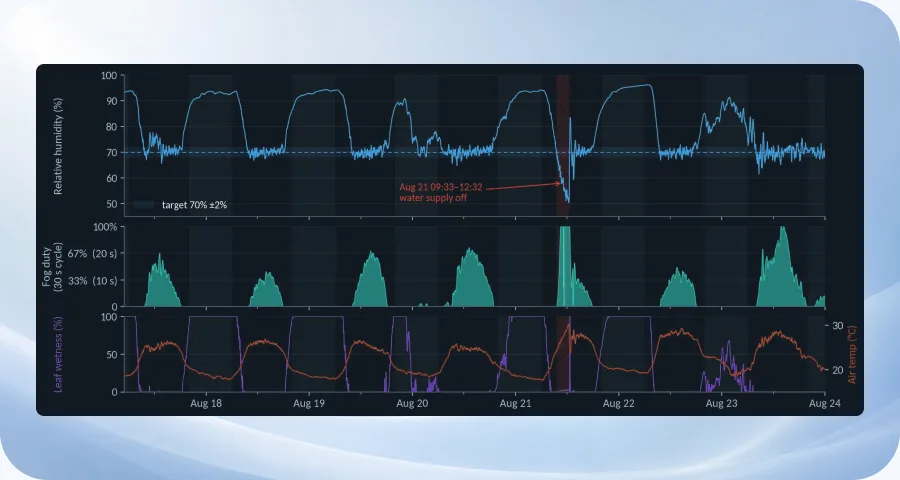
Fog control on a 70 ±2% target: mean 70.3% across the 65.7 hours of fogging in a seven-day trial, 90% of raw samples within ±3%, canopy dry whenever the fog ran.
-
20–40% less irrigation water across deployments; 40% validated on a national forestry organisation’s managed-forest sites.
-
Seven production screens and a GACP-grade audit trail, delivered as 55 custom widgets in the ThingsBoard widget library — no separate backend.
How ThingsBoard powers Seymour Ag Instruments?
One data model for every farm
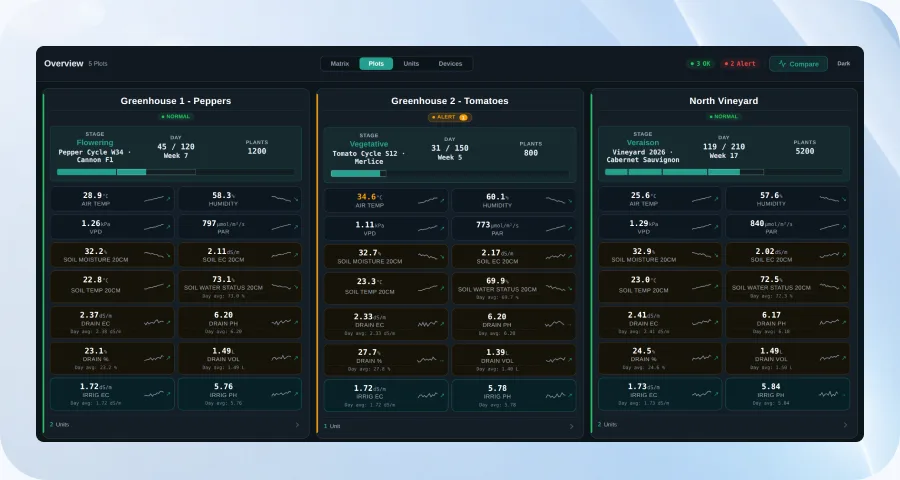
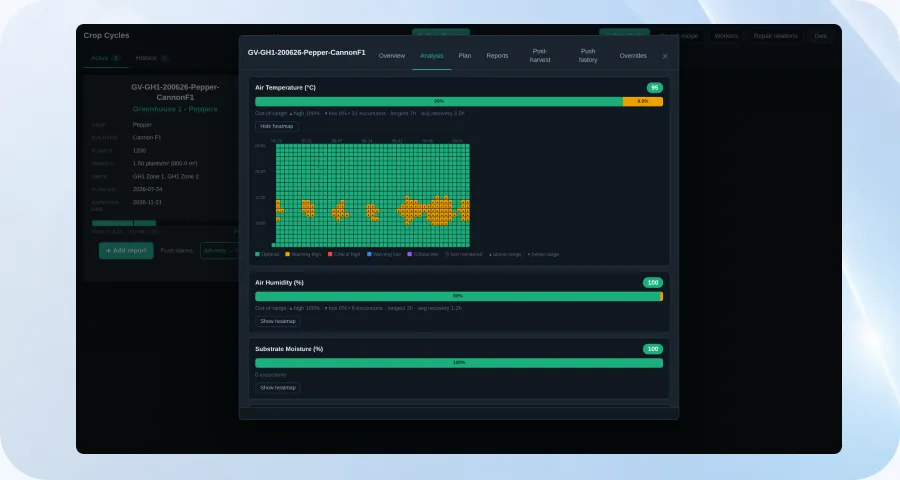
Seymour has run on ThingsBoard since 2022. Each customer’s operation is modelled as assets — Farm, Plot, Unit — with devices at the unit level, and each customer sees only its own hierarchy. Device profiles cover the whole hardware line, from climate sensors and soil probes to runoff stations and controllers. Everything the grower touches is a Seymour widget: seven screens in the ThingsBoard widget library, in four languages, including a right-to-left layout.
Holding 70% humidity on a 30-second cycle
In a Mediterranean greenhouse, a Seymour controller drives a high-pressure fogging line to a 70% humidity setpoint. The loop runs on the controller as a continuous duty cycle on a 30-second period. A leaf-wetness sensor in the canopy cuts the fog back whatever the humidity says. ThingsBoard is the SCADA layer: setpoints live as attributes; telemetry and device-side alarms in the dashboards. Over a seven-day trial the house held a mean of 70.3% across the 65.7 hours the fog line ran, with the leaves dry throughout those hours.
Irrigation on demand, 20–40% less water
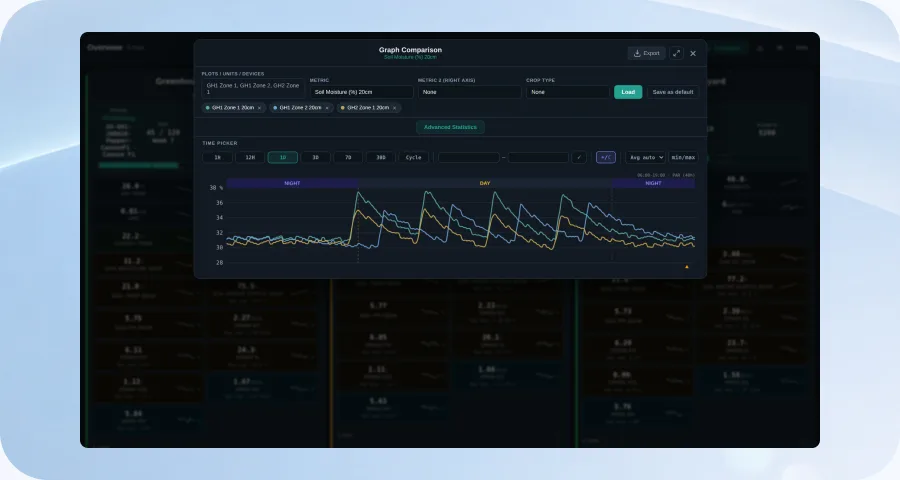
Soil-moisture probes report volumetric water content to ThingsBoard. When a reading crosses the crop’s threshold, the Seymour irrigation controller runs an irrigation event. The platform keeps the thresholds, the telemetry and the record for every plot. On a national forestry organisation’s managed-forest sites this cut water use by 40% against the conventional schedule, and other deployments see similar savings.
Plant-factory control with a GACP audit trail
For a licensed medical-cannabis producer with about 1,000 m² indoors, a Seymour controller drives lighting, dehumidification, CO₂ and air conditioning per growth phase. The crop-cycle manager creates each cycle as an asset with a frozen snapshot of the cultivar recipe. At every phase change it pushes the thresholds to the devices’ alarm rules and logs the dispatch. With the calendar, fertigation records, alarm history, PDF reports and ThingsBoard’s audit logs, that is the per-cycle evidence a GACP inspection asks for. Ninety-two cycles so far.
An AI coding assistant as a native ThingsBoard developer
Seymour’s screens are written with an AI coding assistant, Claude Code, on ThingsBoard’s documented widget API. The assistant behaves like a native ThingsBoard developer, and a screen that once took weeks ships in days. It stays safe: a widget runs in the user’s browser under that user’s permissions, and there is no custom backend to secure. Every widget passes through GitHub and a development bundle first. ThingsBoard CLI, driven by Claude Code, now makes this a supported way of working.

How ThingsBoard helps agriculture improve operations with IoT?
Digital transformation for smarter farming
ThingsBoard empowers agricultural businesses to transition from manual processes to data-driven, automated operations. The platform offers a comprehensive suite of tools that enable real-time monitoring, predictive analytics, and smart automation across farms, greenhouses, storage facilities, and field equipment. One of the most powerful features of ThingsBoard is its interactive dashboards, which allow users to visualise live and historical data from soil sensors, weather stations, machinery, and other connected devices. These dashboards can be customised using an extensive widget library and built with dynamic layouts to create intuitive, responsive interfaces for different user roles and devices.


Scalable design with templates
To support scalability and consistency, ThingsBoard includes templatisation features that allow agricultural teams to easily duplicate dashboard configurations and device logic across multiple locations or projects, accelerating deployment across regions or clients.


Automating agriculture with Rule Engine 2.0
The Rule Engine 2.0 plays a central role in enabling smart automation. It allows users to create low-code workflows that react to incoming data in real time. For example, irrigation systems can automatically activate based on soil moisture thresholds, or alerts can be triggered when storage temperatures exceed safe ranges. These workflows use a visual editor, making them accessible even to non-developers.


Unified ecosystem through seamless integration
ThingsBoard also supports a wide variety of integrations, enabling seamless connection with third-party systems and services via MQTT, HTTP, OPC-UA, Modbus, and more. This allows agricultural operations to consolidate data from diverse equipment vendors and external weather services into one unified platform.


Edge computing for remote reliability
For deployments in remote or low-connectivity areas, ThingsBoard Edge provides local processing and storage capabilities. With centralised edge device management, users can deploy rule chains, dashboards, and updates to field sites, even when operating in disconnected or intermittently connected environments.



Real stories, real impact — share your experience with ThingsBoard!
Contact us