Skip to content
Stand with Ukraine flag
Most popular in IoT Hub

Discover the most popular reusable IoT resources from the ThingsBoard community.

AM308 Lorawan 9-IN-1 IAQ Sensor

AM308 Lorawan 9-IN-1 IAQ Sensor

CO2 Display Lite Temperature and Humidity Sensor

CO2 Display Lite Temperature and Humidity Sensor

reComputer R1100

reComputer R1100

ESP32 Dev Kit V4

ESP32 Dev Kit V4

Contribute to the Community

Help other ThingsBoard users build faster by sharing reusable resources, implementation knowledge, and proven solution components.

How It Works

ThingsBoard IoT Hub helps you discover reusable IoT resources, evaluate them quickly, and apply them in your own ThingsBoard projects.

  • Browse or search for IoT resources Explore resources by category, use case, industry, connectivity, or implementation goal to find the most relevant starting point.
  • Preview and evaluate Review descriptions, screenshots, technical context, integration-related details, and testing options before choosing the resource that fits your scenario.
  • Use and adapt Access reusable assets, setup guidance, implementation resources, and hands-on testing paths that can be adapted to your ThingsBoard environment and project requirements.
  • Contribute back to the community Share your own reusable solutions to help other users and expand the ThingsBoard ecosystem over time.

Frequently Asked Questions

The ThingsBoard IoT Hub is a marketplace built into ThingsBoard where you install ready-to-use components — devices, solution templates, widgets, rule chains, calculated fields, and alarm rules — into your ThingsBoard instance in one step. Instead of building every part of a solution from scratch, you reuse components that hardware vendors, creators, and the ThingsBoard team have already built and maintain.
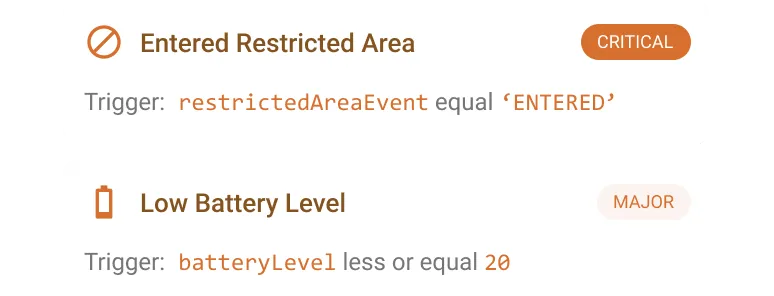
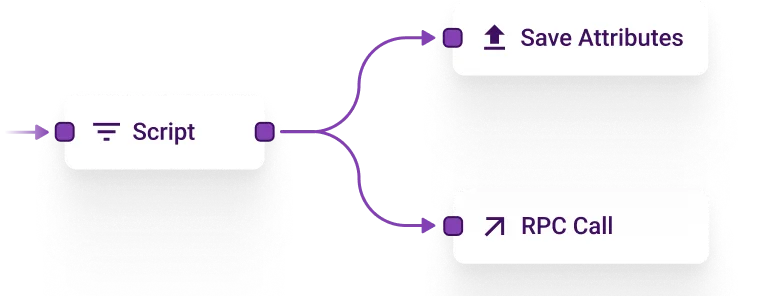
The IoT Hub offers six component types: devices, solution templates, widgets, calculated fields, alarm rules, and rule chains. Each one installs into ThingsBoard in one step, and you adapt it to your data.
You can browse by category, use case, industry, connectivity, or implementation goal, and then evaluate resources based on descriptions, technical context, and supported workflows.
You can discover the IoT Hub components without an account. To install a component, you sign in to your ThingsBoard instance — Community Edition, Professional Edition, or Cloud — and install it there in one step.
Open the component in the IoT Hub and install it into your ThingsBoard instance in one step — it arrives preconfigured. For devices, the connection config and telemetry mapping are already set; for alarm rules and rule chains, the logic is ready to use.
Yes, many resources are designed to be adapted to your environment, data model, and project requirements. The level of customization depends on the specific resource type.
Components are built to speed up implementation, but production readiness depends on your environment and your own validation. Treat a component as a tested starting point you review before deploying.
The IoT Hub is available on every ThingsBoard edition — Community Edition, Professional Edition (Self-Managed), and Cloud (PaaS). The implementation context of every component should be indicated on the relevant category or resource page.
The IoT Device Library is the IoT Hub's catalog of ready-to-use device profiles. Each entry includes the connection config and telemetry mapping for a specific hardware model, plus technical specs and a datasheet where available. Hardware vendors publish and maintain their own profiles.
Each device page shows its readiness — whether a setup guide is available and how it connects to ThingsBoard — so you can tell at a glance what's supported before you install.
You can filter available IoT devices by vendor, hardware type, connectivity, and use case to quickly narrow down device options.
You can add your component via the ThingsBoard Creator Portal. Detailed instructions are available here: How to contribute to IoT Hub. You can also ask for help by email iothub@thingsboard.io
Any of the six component types, along with the details that make it usable — a description, screenshots, configuration examples, and setup guidance.
The ThingsBoard team reviews each contribution before it's published, to keep quality and consistency across the IoT Hub.
Resources in the current stage are intended to be available for free, while access conditions and platform requirements may be specified on individual pages.