Skip to content
Try for free

ThingsBoard Cloud

Choose your data region

Your data stays in the region you choose, for residency and compliance. No credit card required.

Rather run it yourself? Install on your own servers

Re-licensing ThingsBoard Editions into One Source-Available Product

On this page

We have built ThingsBoard for almost ten years, and this is our first real change to how we license it. In version 4.4, our two editions become one: the open Community Edition and the closed Professional Edition merge into a single, source-available product — one ThingsBoard, with the whole platform in it. So it is worth explaining clearly: why now, what changes, and what it means for you.

TL;DR

  • Community and Professional Editions merge into one source-available ThingsBoard under the Business Source License, starting with v4.4. What’s changing →
  • The Free License covers commercial use up to 100 devices on one server. It also covers non-commercial use — for education and nonprofit organizations up to 1,000 devices on any number of servers. How the license works →
  • You need a Commercial License to connect more than 100 devices or remove ThingsBoard branding. Details →
  • All existing ThingsBoard Community Edition installations are protected by the Community Grant Program. It is the program for free migration from CE to the new license model that keeps your current setup running free, forever, at your scale. What this means for you →
  • Advanced security is now free for everyone, in every deployment — we don’t think safety should be a paid feature.
  • Every release turns fully open source (Apache 2.0) four years after it ships.

Why now

The honest answer to “why now” is AI. AI coding assistants only became genuinely useful at the end of 2025 — before that, they were an unreliable novelty. Today, someone running Community Edition can read the code, build on it, tune it, connect it to their own systems, and keep it running. When open code and AI are this powerful together, the right move is to open more of ThingsBoard, not less.

We want all our customers to have the same freedom to work with the source code. PE users invest the most in ThingsBoard and run its most demanding deployments, so opening the code to them is the natural next step. Now they can read it, build on it, and use AI on it.

One ThingsBoard Edition also ends an old problem. We no longer have to decide whether each new feature belongs in CE or PE. Features reach everyone at once, and you never have to check which edition has what.

Open code still needs one limit, though. The new license is what keeps ThingsBoard’s development sustainable.

What’s changing
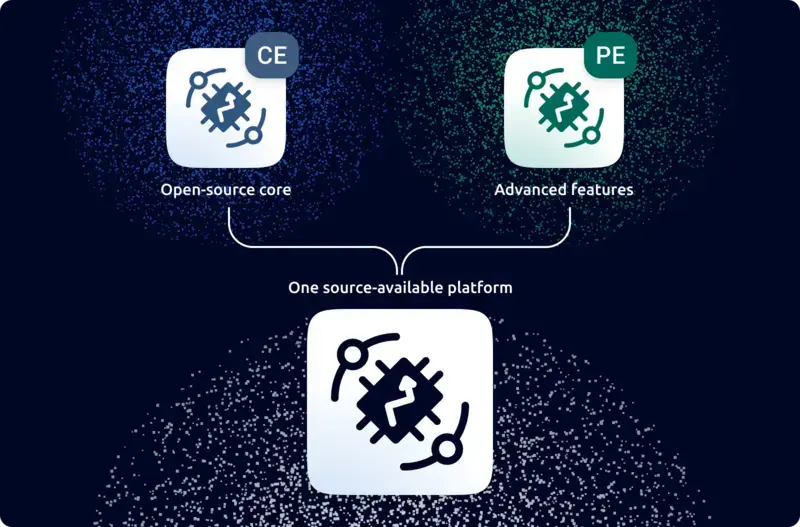
Community Edition, the open-source core, and Professional Edition, with its advanced features, merging into one source-available ThingsBoard platform

From version 4.4, both CE and PE are merged into one ThingsBoard. The features that were locked in Professional Edition — integrations, the scheduler, reporting, and advanced security — now sit in the same public GitHub repository, and every release becomes fully open source (Apache 2.0) four years after it ships.

Security becomes a core, free feature of ThingsBoard. Cybersecurity and data protection matter more every year, so this is the part we most wanted to get right. The security we have hardened over the years — single sign-on, fine-grained access control, and secrets management — is now available for everyone, in every deployment. Strong protection should be the default in any product from day one, not an upsell — and we hope more projects make the same choice.

A Commercial License is no longer a feature gate: every feature is available in both free and paid deployments, and you pay only when you scale or use your own branding.

How the license works

From 4.4, ThingsBoard uses the Business Source License 1.1 (BUSL) — a source-available license first created by MariaDB in 2013 and adopted by many projects, like Terraform, Vault, Couchbase and many others. It is part of the Fair Source movement, and enterprise legal teams already know it well.

Free LicenseNeeds a Commercial License
Run, self-host, modify, submit pull requestsOutgrow the number of devices or servers included in the Free License
Commercial use: up to 100 devices on one server with ThingsBoard brandingAdd your own branding
Non-commercial use: up to 1,000 devices, any number of servers with ThingsBoard branding

Every release becomes Apache 2.0 — fully open source — four years after it ships.

The short of it:

  • The source stays public on GitHub. You can read, build, change, run it, and submit pull requests, just like before.
  • It is not open source in the strict sense — it is source-available. We’d rather say that plainly. But it is far from closed, and every release becomes fully open source (Apache 2.0) four years after it ships.
  • The limit fits in one sentence: you can use ThingsBoard freely unless you exceed the free-tier device limit or remove ThingsBoard branding. Any of those needs a Commercial License — at the same price as Professional Edition before relicensing.
  • The free license: self-hosted, with ThingsBoard branding. For commercial use — up to 100 devices on one server. For non-commercial use (education, non-profit organizations) — up to 1,000 devices, on any number of servers.

We won’t pretend there is no trade-off. Community Edition was Apache 2.0, and new releases now spend four years as source-available before they return to Apache. In return, the Professional Edition code becomes open for the first time. The free-tier device limit and the Community Grant Program keep the balance sustainable.

Imagine a small system integrator building a refrigeration-monitoring solution for grocery stores. The system collects temperature data, sends alarms, and gives store managers monitoring dashboards.

Stage 1. Building and testing the solution (Free)

The integrator connects 30 sensors in its workshop to develop the dashboards, alarms, reports, and integrations. No customer is using the system yet, and it is being used only for development.

Stage 2. Deploying for the customer (Free)

The integrator installs 80 sensors in one grocery store and runs them on one self-hosted server. The customer uses the standard ThingsBoard-branded interface. The integrator may charge for the hardware, installation, configuration, and support.

Stage 3. Expanding the deployment (Commercial License)

The customer adds more refrigerators and opens a second store. The same deployment now manages 160 devices. It still uses the ThingsBoard name and branding.

Stage 4. Turning it into the integrator’s own product (Commercial License)

The integrator now offers the solution to other grocery stores as ColdWatch, with its own logo, colors, domain, and customer portal. It sells the solution as part of its own commercial offering.

The rule is straightforward: a small ThingsBoard-branded commercial deployment can remain free — you can build a solution on ThingsBoard and sell it to your customers on the free tier, as long as the ThingsBoard branding stays in place. A license is required in two cases only: when the deployment grows beyond 100 devices, or when ThingsBoard branding is replaced with your own.

What this means for you

The change means different things depending on how you use ThingsBoard today. Here it is for each group.

If you use ThingsBoard Cloud

Nothing changes. ThingsBoard Cloud is our managed, hosted service. This announcement is about the self-hosted product and its license. It does not affect your Cloud plan, your pricing, or your daily use.

If you’re a Professional Edition customer

You gain something and lose nothing. ThingsBoard is now one source-available product, so the code is open to you: read it, build it, change it, debug against it, and use your own tools and AI on it. Everything else stays the same — your agreement, your pricing, and your support do not change. One note on plans: the entry-level self-hosted Maker and Prototype plans are being retired.

If you run ThingsBoard Community Edition

First, the practical part. The latest ThingsBoard CE LTS release (v4.3) stays on Apache 2.0 and keeps getting security updates until July 20, 2027. You can keep running on it as long as you want. Nobody who runs ThingsBoard Community Edition today will ever pay for what they already have.

When you are ready to move to v4.4 (LTS) and later releases, the Community Grant is your free path. Register for the Community Grant Program — it is free, self-service, and usually takes under a minute. The Community Grant is a type of license that allows you to lock in the user data available as of the release date, plus a 10% buffer for devices (up to 1,000 extra devices). So it lets you run the 4.4 version for free at the scale you already run, plus 10% of headroom. Your branding, your data, and any white-labeling you have already applied all carry over, at your current scale, with no back-payment, ever.

A few examples, all under the Community Grant Program:

  • You run a 30-device workshop → you’re simply free, and stay that way at that size.
  • You run 5,000 devices internally → 5,500 are free forever; grow to 7,000 and you pay standard pricing only for the 1,500 above, nothing for the 5,000 you already ran.
  • You already white-label 30,000 devices → 31,000 stay free, white-labeling included, no back-payment; if a customer pushes you to 40,000, you pay only for the 9,000.

Past your scale, the only thing that triggers a bill is growth — more devices, or more production servers — at standard pricing for the additions only. The full Professional feature set is not part of the free grant. That is only fair to the customers who already pay for Professional Edition. If you want it, you can buy a Professional Pack — an add-on that transforms the Community Grant to a Commercial License. It includes White Labeling for users who didn’t use it before the re-licensing, and commercial support. You can add optional maintenance to keep updates and support current.

Registration opens on announcement day and closes on July 20, 2027. Register any time in between. If you run a large fleet, we’ll help you through it. For the full terms and more examples, read about the Community Grant Program.

The full details are in the FAQ alongside this post — how the free tier is counted, what “white-labeling” and “commercial use” mean, how to register, and what happens to older versions.

If something isn’t clear or your case isn’t covered, ask us. We’ll answer, and update the FAQ so it’s there for the next person too.
FAQ

Your existing agreement, pricing, license, white-labeling rights, and support remain unchanged — and you gain access to the merged product's source code. Anything you newly purchase is offered under the current commercial terms.

Your subscription continues automatically. You can contact us if you want to replace your current license with a Free License.

Keep what you run today free. The Community Grant Program covers your current deployment at its registered scale; you pay only for growth beyond it. Read the full terms, or talk to us about your deployment.

Community Grant Program

No. This change applies to the on-premises (self-hosted) ThingsBoard. Cloud plans, pricing, and customer experience remain unchanged.

No — the license covers only the platform repository. Software products we publish in separate repositories are licensed under their own terms.

You can keep reading, building, modifying, and submitting pull requests exactly as before. One new step: on your first pull request you will be asked to sign the ThingsBoard Contributor License Agreement once, through a link in the pull request; it takes a minute, and a signature covers all your later contributions. The CLA does not take your copyright: you keep it and grant us a license to use your contribution under the project license and to relicense it as ThingsBoard, Inc. relicenses the project.

Production use is free under a Free License if either:

  • commercial use with up to 100 devices across your Organization, on no more than one Production Instance;
  • non-commercial use — education and non-profit organizations — with up to 1,000 devices, on any number of Production Instances.

If your organization is educational or non-profit and the use has no commercial purpose, you're on the non-commercial track: up to 1,000 devices, any number of Production Instances.

If your project has no commercial purpose, you are on the non-commercial track: up to 1,000 devices. If it earns money or serves a business, the commercial track: up to 100 devices on one server.

We count the individual units you monitor or control — not tags, data points, or platform records.

  • A pump with 5 temperature sensors, 5 flow meters, 3 pressure sensors, a PLC, and a gateway is one device: all those readings describe the same machine.
  • A fleet of 50 trucks is 50 devices.
  • One gateway forwarding data from sensors in 100 rooms is 100 devices — one per monitored room.
  • Gateways, PLCs, and other intermediaries aren't counted for data they merely forward. How you model things on the platform doesn't change the count.

Per Organization: you together with every entity that controls, is controlled by, or is under common control with you. Devices are counted across all your deployments, added together — including deployments run for you by someone else. Splitting a fleet across Production Instances or accounts doesn't multiply the Free License.

It depends on the track.

Commercial (up to 100 devices): production runs on one Production Instance — a fully functional deployment corresponding to a single server process.

Non-commercial (up to 1,000 devices): no limit on Production Instances.

A process that only does auxiliary UI, transport, or integration work is not a fully functional deployment, so it is not a separate Production Instance — a small setup with separate transport nodes still qualifies. A cluster is different: it runs at least two services of the same type, so each one counts, and commercial production on a cluster needs a Commercial License.

Three things:

  • white-labeling — replacing or removing the ThingsBoard branding, at any scale;
  • help desk — the official technical support channel for priority assistance;
  • scale — more than 100 devices commercially (or more than 1,000 non-commercially), or commercial production on more than one Production Instance.

White-labeling means removing or replacing the visible ThingsBoard branding — so swapping the ThingsBoard logo or name for your own is white-labeling and needs a Commercial License (or a Professional Pack for Community Grant Program participants), at any scale.

Configuring dashboards, themes, colors, and content while the "Powered by ThingsBoard" attribution stays visible is not white-labeling and is free.

You may serve your clients from a deployment you operate, including multi-tenant, under your own key. Their devices count toward your Organization's limits, and ThingsBoard branding must stay visible. A client that runs its own deployment needs a key issued to its own Organization. When the total scale outgrows the Free License, or you need to white-label your solution, you need a Commercial License.

Yes — that has always been the intent, and it's free as long as:

  • your Organization's devices stay within your Free License limits;
  • the "Powered by ThingsBoard" attribution stays visible (you haven't white-labeled).

When the total scale outgrows the Free License, or you need to white-label your solution, you need a Commercial License.

Yes. You sell your services; the client is the licensee with their own key and limits. Nothing in the license restricts consulting, integration, configuration, or support work.

Both are variants of the same Commercial License.

Subscription: a recurring fee; new versions are included while active. On cancellation, the deployment reverts to the Free License if it fits; otherwise, it moves to restricted operation until you restore a valid license.

Perpetual: a one-time purchase, yours forever; new versions after the first year require the update fee — not paying it changes nothing about the versions you already have.

Pricing for scale, white-labeling, and commercial support is published on the Pricing Page, and it is the same as it was for Professional Edition before relicensing — the price has not gone up. For existing Community users, the Community Grant covers your current scale for free; you pay only for growth beyond it, and optionally for a Professional Pack.

For production — yes: every production deployment runs with a key from the ThingsBoard License Portal. A Free License key is issued instantly, self-service, at no charge; paid scopes get a key with purchase. For development, testing, and anything non-production, no key is needed. Without a key, the software runs in development mode: unlimited devices, a visible development notice, and the full feature set except white-labeling.

Keyless development mode counts cumulative run-time up to 30 days; a free Development key waives that limit (the deployment stays under the development notice and confirms non-production use every 30 days) and registers you so we can send security notices.

Building from source with the license check disabled is the same keyless development mode. Development mode is a technical state, not a license status — it never reclassifies production use: if real operations depend on the deployment, it needs a production key regardless of the mode, the notice, or what you name the environment.

Nothing breaks.

Existing devices, data, and services keep working; only new device connections are refused until capacity is increased. We never disconnect running devices or delete data.

This works the same on every path — Free License, Community Grant, and Commercial License: the limit gates new connections only, and capacity can be increased at any time through the License Portal.

Yes. An offline key is available for a Perpetual License where your Order authorizes an Offline Deployment: it encodes your licensed scope in the key itself and needs no validation against our license server.

Get it from the License Portal on any machine with internet access, then activate your deployment with it. (An online key, by contrast, is validated periodically and tolerates interruptions of up to 48 hours. After that, the management interface locks until the next successful check. Connected devices keep sending data, and nothing is deleted.)

Under a standard online license, the instance contacts our License Server to validate the license (about hourly) and, by default, attaches a usage snapshot about every 12 hours.

The snapshot contains only aggregate, installation-wide technical figures: entity counts (tenants, devices, assets, users), which features are in use and how heavily, previous-day processing volumes, database size, product version, and packaging.

It never contains device telemetry or message content, entity or user names, credentials, configuration, or scripts, and it doesn't break anything down by tenant, user, or device. We're honest about one thing: this data isn't anonymous — it travels with the identifiers used for license validation, which is what makes compliance work. We also record the network address your instance connects from.

You can switch the usage snapshot off at any time with a documented flag — licensing, functionality, and support are unaffected; validation and the connecting-address record continue.

Offline licenses don't send the usage snapshot at all.

Instead, each node performs a short license check-in at startup and about hourly: the customer and subscription identifiers in the offline license, plus software version and packaging — no usage counters, no telemetry, no data about your users.

A genuinely disconnected environment simply never delivers these check-ins, and the platform keeps working regardless.

Distributing and selling builds is allowed.

Your production deployment, though, must run a key issued to your Organization — register at the License Portal (free within the Free License limits). A key issued to the vendor's Organization doesn't cover your deployment.

  • An 18-month "beta" with 500 customer installations — production (customers rely on it).
  • A two-year R&D build with 10 bench devices and no customers — non-production (take as long as you need).
  • A full-scale staging mirror beside a real deployment — non-production; its devices are already counted once in production.

The Business Source License 1.1 (BUSL). The source code is public: anyone may read, copy, modify, fork, and redistribute it, and use it freely for development and testing — no key, no conditions. Production use is free within the limits above. Four years after each version's release, that version automatically becomes Apache 2.0.

Strictly speaking, no — while the BUSL restrictions apply, ThingsBoard is source-available, not OSI-approved open source, and we say that plainly. The full source stays public on GitHub, and every release automatically converts to Apache 2.0 (true open source) four years after it ships.

The complete source code stays public on GitHub. You can read it, build it, modify it, self-host it, fork it, and submit pull requests. The license restricts only production use beyond the free limits without a Commercial License.

Each version converts to Apache 2.0 exactly four years after its own release date — the LICENSE file states the rule ("four years from the date the Licensed Work is published"). For ThingsBoard 4.4.0, released , that means .

In the LICENSE file at the root of the ThingsBoard GitHub repository. We encourage customers and their legal teams to review it directly — the license, not this FAQ, is the legally operative text. Paid licenses are governed by the ThingsBoard License Agreement.

Registering at the License Portal means accepting the License Portal Terms of Use and the Privacy Policy — nothing about the software yet.

What you accept for the software depends on the key.

A Free License key (non-commercial, or no-charge commercial within the Additional Use Grant) is issued on your acceptance of the BUSL and the Portal Terms — the ThingsBoard License Agreement does not apply to no-charge use.

A paid Commercial License is accepted at checkout, together with your Order: the ThingsBoard License Agreement, its Order, and the Portal Terms.

It is the part of the BUSL license file where we grant free production use. "Additional" means additional to the base rights (copy / modify / fork / redistribute / non-production) — not "extra payment." Everything in the Additional Use Grant is free.

Only to no-charge production use. Forks, development, testing, CI, and research need no key and carry no conditions — they run under the base grant.

If real devices are sending you real data and it matters that it keeps working, that is production use — whatever you call the environment. Everything else is non-production: development, testing, QA, staging, CI, training. Non-production is free, with no device limit, for as long as you like. The boundary is drawn by the nature of the use, not the software mode or the key. Evaluating with real devices is non-production while nothing depends on it. The keyless development mode you evaluate in runs for 30 days of cumulative operating time (Terms of Use, section 5), and a free Development key extends it. Once real operations rely on the deployment, it is production and needs a production key.

A standby that receives replicated data but serves no users and sends no commands is not production use until it is activated. Its devices are already counted once — in the deployment it mirrors — and for the commercial Free License, a passive standby does not count against the one-instance condition: you have one Production Instance at any moment, and on failover the standby becomes it. A staging mirror restored from a production backup is the same.

Yes. Internal use is still production use: a dashboard three of your engineers use to watch real machines is production. What matters is that real operations depend on it, not who the users are.

The honest answer is AI. Coding assistants only became genuinely useful at the end of 2025; today, anyone running the source can read it, build on it, and use AI on it — so when open code and AI are this powerful together, the right move is to open more of ThingsBoard, not less.

Merging Community and Professional into one product also ends the question of whether each new feature belongs in CE or PE — features reach everyone at once.

No. Existing Community Edition users keep their current deployment free at its registered scale through the Community Grant Program and pay only for future growth. New users get a Free License that didn't exist before.

Every feature is now free for everyone — the only paid things are white-labeling, commercial support, and scale beyond the free limits.

Yes. There is now one product, so the Free License and the Community Grant get the same platform and the same improvements — there is no "lesser" edition to fall behind. Everything already released stays Apache 2.0 forever, and every new release becomes Apache 2.0 four years on.