
Delivery guarantees
MQTT Quality of Service (QoS) defines the delivery contract between sender and receiver for each message. It answers one question: what guarantee does the sender need that the receiver got the message? Three levels are available — each a trade-off between reliability and the number of network round trips required.
Choosing the right level matters because the wrong choice in either direction has a cost: QoS 0 loses messages on unreliable links; QoS 2 adds four-packet overhead to every message and can become a bottleneck at high throughput. Most IoT deployments use QoS 1 as the default and reserve QoS 2 for the small subset of messages where duplicate processing would cause real harm.
Comparison
Section titled “Comparison”| QoS 0 | QoS 1 | QoS 2 | |
|---|---|---|---|
| Guarantee | At most once | At least once | Exactly once |
| Delivery | Best-effort | Guaranteed | Guaranteed |
| Duplicates possible | No | Yes | No |
| Packets | 1 | 2 | 4 |
| Relative overhead | Lowest | Medium | Highest |
| Offline queuing | No | Yes (persistent session) | Yes (persistent session) |
QoS 0 — at most once
Section titled “QoS 0 — at most once”The message is sent once with no acknowledgement. If the network drops the packet, it is lost.
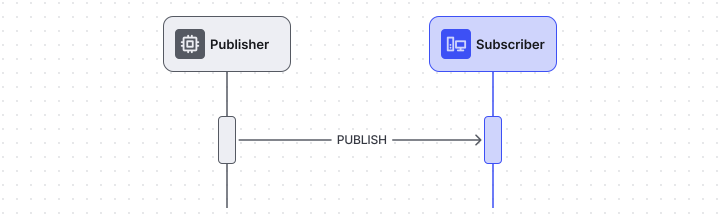
The sender removes the message from its queue immediately after sending. No retry, no confirmation.
Use when: message loss is acceptable and recency matters more than completeness. Typical examples: high-frequency sensor readings where the next value will arrive within seconds, UI state broadcasts, or metrics where an occasional gap is tolerable.
QoS 1 — at least once
Section titled “QoS 1 — at least once”The message is delivered at least once. The sender retransmits until it receives a PUBACK.
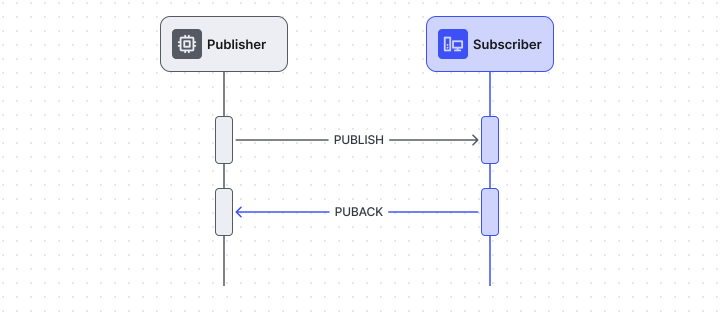
If the PUBACK is lost in transit, the sender retransmits with the DUP flag set. The receiver may therefore
process the same message more than once, so consumers must be idempotent — able to handle duplicates safely.
Use when: every message must arrive, and your processing logic can tolerate or deduplicate repeated delivery. Typical examples: telemetry from vehicles, security alerts, device state changes.
QoS 2 — exactly once
Section titled “QoS 2 — exactly once”The message is delivered exactly once through a four-packet handshake that prevents both loss and duplication.
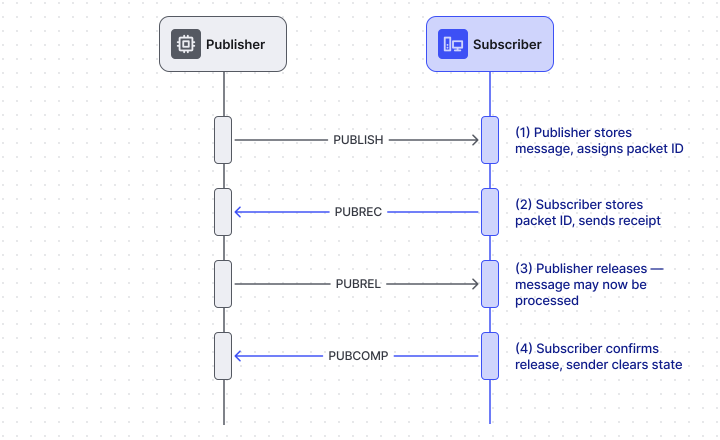
Neither side may reuse the packet ID until the full handshake completes.
This is what guarantees exactly-once delivery: the receiver will not process the message until step 3 (PUBREL),
and both sides persist enough state to resume after a crash.
Use when: duplicate processing causes real harm. Typical examples: financial transactions, actuation commands on industrial machinery, billing events.
QoS downgrade
Section titled “QoS downgrade”When the publisher’s QoS and the subscriber’s QoS differ, TBMQ delivers the message at the lower of the two levels.
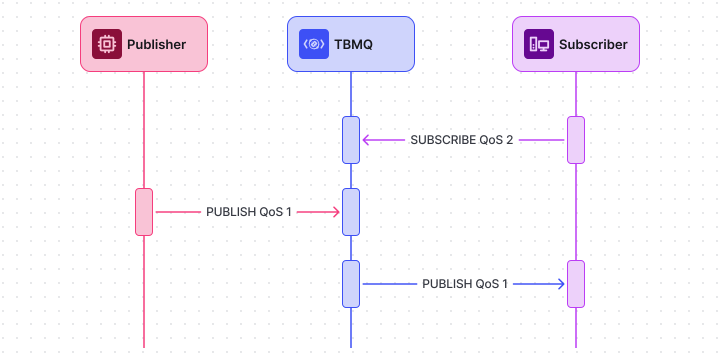
This means a QoS 2 subscription does not guarantee exactly-once delivery if the publisher sends at QoS 0 or QoS 1. Design for the actual delivered level, not the subscribed level.
QoS and session persistence
Section titled “QoS and session persistence”QoS 1 and QoS 2 messages are only queued for offline clients when the subscriber uses a persistent session. With a non-persistent (clean) session, undelivered messages are discarded on disconnect regardless of QoS.
| Session type | QoS 0 | QoS 1 / QoS 2 |
|---|---|---|
| Non-persistent | Discarded on disconnect | Discarded on disconnect |
| Persistent | Discarded on disconnect | Queued, delivered on reconnect |
For QoS 0 specifically, the broker never queues messages — even in a persistent session.
For details on how TBMQ stores queued messages per client type, see Sessions.
Choosing a level
Section titled “Choosing a level”| Situation | Recommended level |
|---|---|
| High-frequency sensor data; loss of one reading is harmless | QoS 0 |
| Device telemetry that must reach the backend | QoS 1 |
| Commands sent to a device (on/off, setpoint) | QoS 1 with idempotent handling |
| Financial or billing events | QoS 2 |
| Industrial actuation where duplicate execution causes damage | QoS 2 |
| Analytics consumer that must process every event exactly once | QoS 2 (publisher and subscriber) |
Was this helpful?