
Clustering
TBMQ is designed to scale horizontally by adding broker nodes to a cluster. Every node is identical in capability — there is no master, no coordinator, and no node that holds privileged state. Any node can accept any client connection, and if a node goes down, clients reconnect to any remaining node and resume without data loss.
This symmetry is possible because TBMQ delegates shared state to Kafka. Sessions, subscriptions, and all published messages live in Kafka topics, not in broker memory. Broker nodes maintain local in-memory copies for performance, but always treat Kafka as the source of truth. A newly joined node bootstraps its local state from Kafka and becomes fully operational without any manual intervention.
Standalone vs cluster
Section titled “Standalone vs cluster”TBMQ runs identically in standalone and cluster modes — there is no configuration switch or different binary. A standalone deployment is simply a cluster of one. When you need more capacity, add nodes.
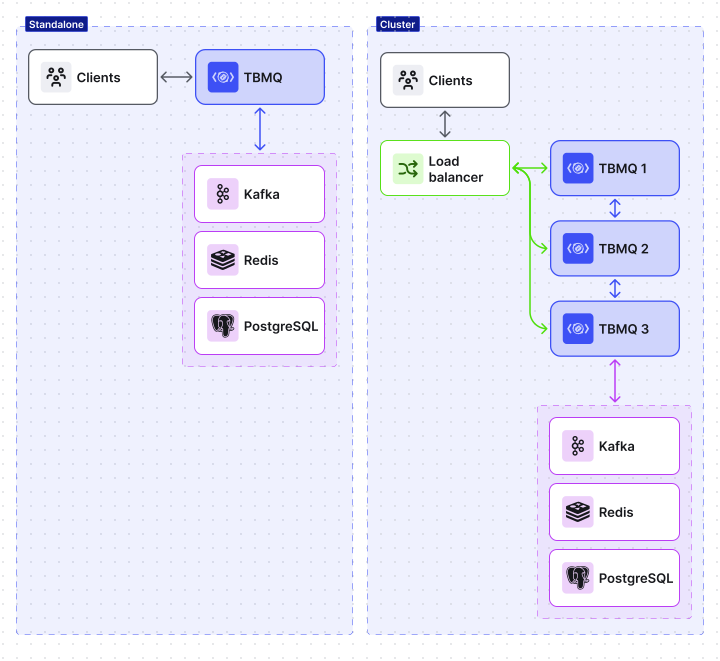
A load balancer distributes incoming MQTT connections across all available nodes. Any standard TCP load balancer works — TBMQ has no affinity requirements. If a node fails, the load balancer routes new connections to healthy nodes, and existing clients reconnect automatically.
How state is shared
Section titled “How state is shared”All state that must survive a node failure or be visible to other nodes is stored in Kafka:
| State | Kafka topic | Who reads it |
|---|---|---|
| All published messages | tbmq.msg.all | All nodes (same consumer group) |
| Client sessions | tbmq.client.session | All nodes on startup and on changes |
| Client subscriptions | tbmq.client.subscriptions | All nodes on startup and on changes |
| DEVICE persistent messages | tbmq.msg.persisted | All nodes (same consumer group) |
| APPLICATION messages | tbmq.msg.app.$CLIENT_ID | Only the node where that client is connected |
Each node maintains a local in-memory Subscription Trie built from the client subscriptions topic. When a message arrives at any node, that node can independently determine which clients should receive it — no coordination with other nodes required for the matching step.
Message routing across nodes
Section titled “Message routing across nodes”Because any node can process any published message, but a subscriber may be connected to a different node, TBMQ uses dedicated Kafka topics for cross-node delivery:
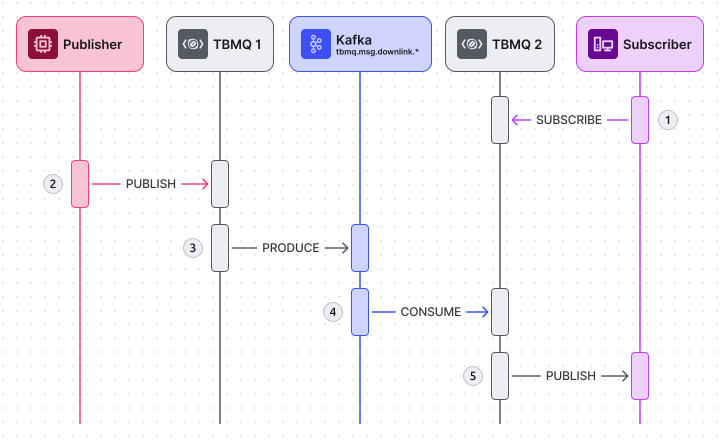
Two downlink topics exist per node:
tbmq.msg.downlink.basic.$SERVICE_ID— for non-persistent DEVICE subscriberstbmq.msg.downlink.persisted.$SERVICE_ID— for persistent DEVICE subscribers
APPLICATION clients do not require inter-node routing. When an APPLICATION client connects to a node,
that node creates a dedicated Kafka consumer for the client’s topic (tbmq.msg.app.$CLIENT_ID) and processes
its messages locally. No message ever needs to cross to another node for APPLICATION delivery.
How each traffic pattern scales
Section titled “How each traffic pattern scales”The three MQTT traffic patterns scale differently in a TBMQ cluster:
Fan-in (many publishers, few subscribers)
Section titled “Fan-in (many publishers, few subscribers)”How a published message flows from a device to its APPLICATION consumer:
- A device connects to any broker node and publishes a message.
- That node writes the message to the shared
tbmq.msg.allKafka topic. - All broker nodes consume
tbmq.msg.allas a single consumer group — each partition is handled by exactly one node. - The node that owns the matched APPLICATION consumer delivers the message locally to its client.
The consumer group load-balances the tbmq.msg.all partitions across nodes.
Add Kafka partitions and broker nodes together to increase ingestion throughput linearly.
Fan-out (few publishers, many subscribers)
Section titled “Fan-out (few publishers, many subscribers)”How one published message reaches N subscribers spread across the cluster:
- The publisher sends a message to its broker node — call it Node A.
- Node A’s in-memory Subscription Trie matches the topic to N subscribers.
- Subscribers connected to Node A are delivered to directly, with no extra hop.
- Subscribers on other nodes are reached via the target node’s dedicated downlink topic in Kafka — for example,
tbmq.msg.downlink.basic.$NODE_B_IDfor Node B.
Each broker node delivers to the subscribers it owns directly. Cross-node delivery goes through per-node downlink topics. Fan-out throughput scales by adding nodes — each node handles its share of the subscriber population.
Point-to-point (one publisher, one subscriber)
Section titled “Point-to-point (one publisher, one subscriber)”How a message reaches exactly one targeted subscriber — the same path as fan-out, but with a single match:
- The publisher sends a message to its broker node.
- That node’s Subscription Trie matches the topic to exactly one subscriber.
- If the subscriber is on the same node, the message is delivered directly — no cross-node hop.
- If the subscriber is on a different node, the message is forwarded through that node’s dedicated downlink topic in Kafka.
Co-locating publisher and subscriber on the same node eliminates the cross-node hop entirely, yielding the lowest possible broker latency for targeted messaging.
No single point of failure
Section titled “No single point of failure”The symmetric design eliminates the failure modes that affect coordinator-based brokers:
| What fails | Impact on TBMQ |
|---|---|
| One broker node | Clients on that node reconnect to any other node. Sessions and subscriptions restored from Kafka. In-flight messages redelivered via QoS 1/2. |
| Kafka broker (with replication) | Shared consumer groups (tbmq.msg.all, tbmq.msg.persisted) pause during partition rebalance. APPLICATION per-client consumers (direct partition assignment) wait for partition leader election. Processing resumes from the last committed offset — no message loss, but messages polled before the last commit may be redelivered. |
| Redis node | DEVICE persistent message delivery pauses until a replica is promoted to primary (Redis Sentinel or Redis Cluster failover). No data loss with replication enabled. |
Scaling guidelines
Section titled “Scaling guidelines”Add broker nodes when CPU or connection count on existing nodes is the bottleneck. Nodes join the cluster automatically — no rolling restart required for the existing nodes.
Add Kafka partitions to tbmq.msg.all when message ingestion throughput is the bottleneck.
Each additional partition allows one more parallel consumer thread across the cluster.
Scale Redis with Redis Cluster when DEVICE persistent message storage is the bottleneck. Redis Cluster distributes keys across shards, each shard backed by a primary and replicas.
Scale PostgreSQL vertically or with read replicas. PostgreSQL handles metadata and credentials, not the high-throughput message path, so it rarely becomes the first bottleneck.
For a full component diagram and the complete list of Kafka topics used internally, see the Architecture page.
Was this helpful?