Data Filtering
Drag any field into the Filter section of a view to restrict which data points are included. Filters can be applied to fields that are not shown in the visualization — for example, filter out empty apartments by floor number without adding floor number as a chart axis. All active filters are combined with AND logic — a data point must satisfy every filter to be included. If no data matches, the view displays an empty state.
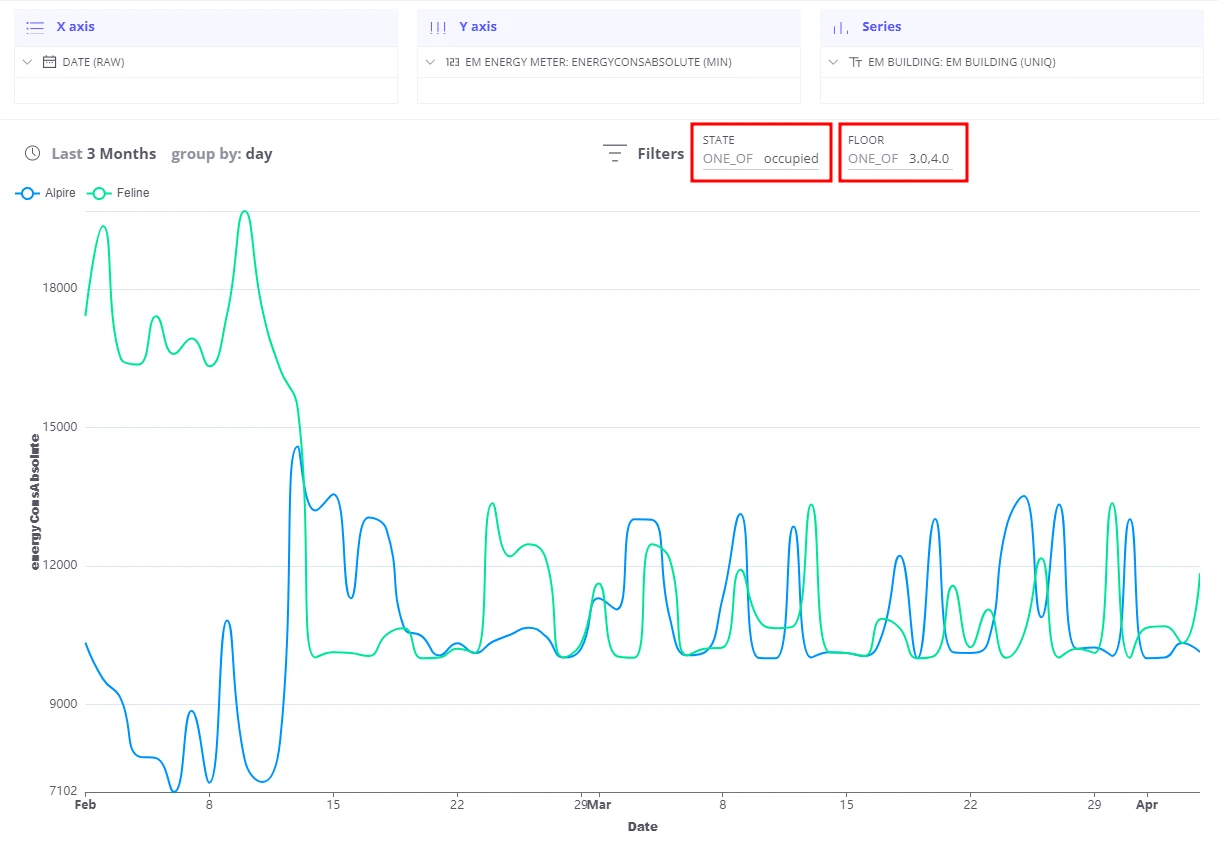
Filterable fields
Section titled “Filterable fields”Any field present in ThingsBoard can be used as a filter:
| Field type | Examples |
|---|---|
| Asset / Device name | Filter to a specific device or asset by name |
| Asset / Device label | Filter by the label assigned in ThingsBoard |
| Asset / Device owner | Filter by the customer the entity belongs to |
| Attribute | Any server-side, shared, or client-side attribute |
| Telemetry | Any time-series telemetry key |
Filter conditions
Section titled “Filter conditions”The available conditions depend on the field’s data type:
| Data type | Available conditions |
|---|---|
| Text | Any, One of, Not one of, Starts with, Ends with, Contains, Does not contain |
| Numeric | Any, One of, Not one of, Greater than, Greater or equals, Less than, Less or equals |
| Boolean | Any, One of, Not one of |
| Date | Hour, Day, Date, Month — see Filter by date |
The condition controls what input appears in the filter dialog:
| Condition | Input |
|---|---|
| Any | No value required — passes all data |
| One of, Not one of | Pick one or more values from a list |
| Starts with, Ends with, Contains, Does not contain | Enter a text string (case-sensitive) |
| Greater than, Greater or equals, Less than, Less or equals | Enter a number |
For Boolean fields, One of / Not one of shows true and false as the selectable options. Click the filter field to open its configuration dialog and choose the required condition.
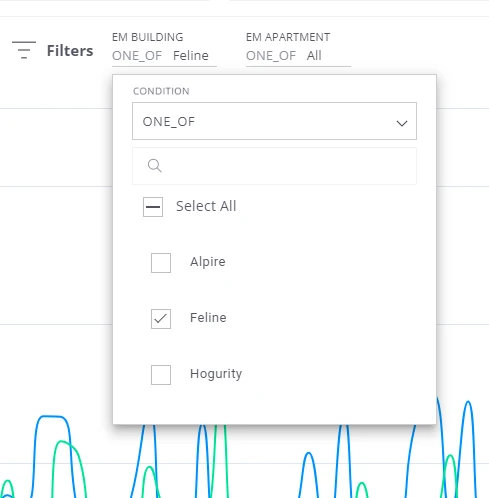
Filter by hierarchy
Section titled “Filter by hierarchy”When assets or devices are connected by relations, you can filter by a parent entity to scope the view to its children only.
Example: Buildings contain Apartments. Dropping Building name into the Filter section and selecting a specific building limits the view to apartments from that building only.
The same logic applies to customer ownership — dropping the Owner field filters all entities to those belonging to the selected customer.
Filter by Date
Section titled “Filter by Date”The date filter restricts which telemetry data points are included based on a repeating calendar dimension. It works alongside the overall time range — for example, a 90-day time range combined with a weekdays-only date filter returns weekday data from the last 90 days.
| Date dimension | Filters by | Values |
|---|---|---|
| Hour | Hour of the day | 0–23 |
| Day | Day of the week | Mon–Sun |
| Date | Day of the month | 1–31 |
| Month | Month of the year | Jan–Dec |
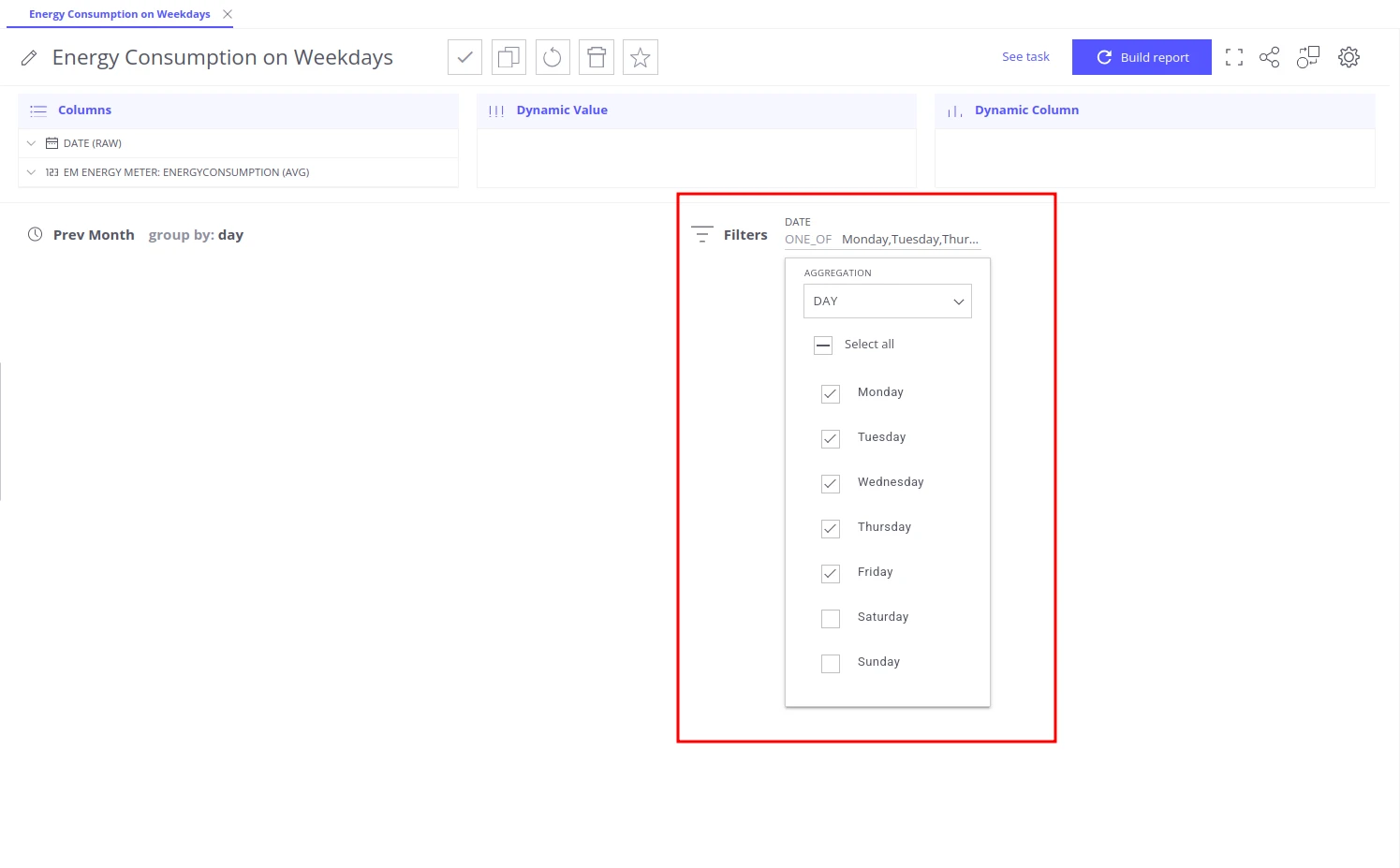
Example — weekdays only:
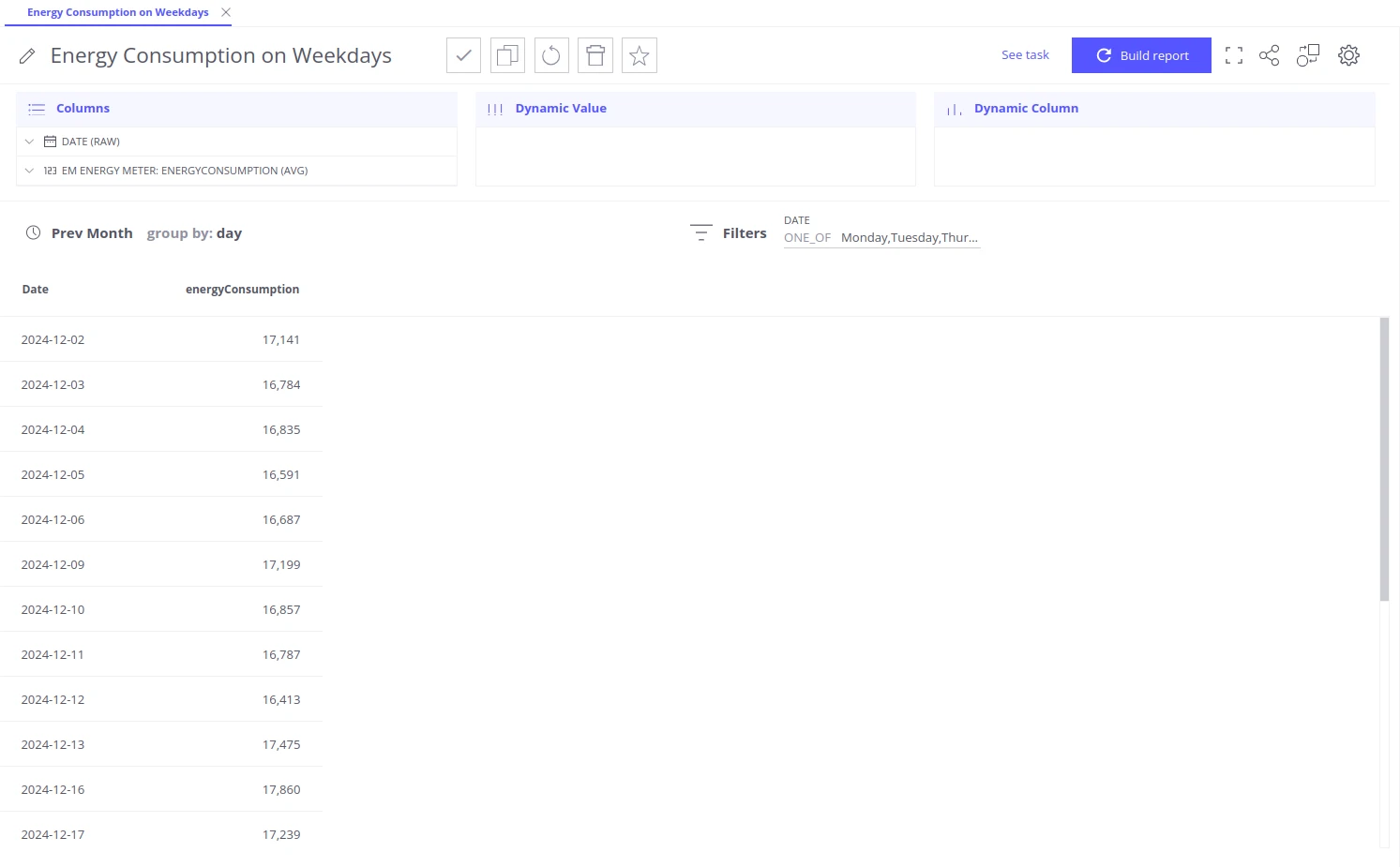
Add a Date field to the Filters section, open its dialog, set the dimension to Day, and select Monday through Friday. The view will include only data points that fall on weekdays, regardless of the selected time range.
Dynamic filter values
Section titled “Dynamic filter values”Filter values can be driven by a ThingsBoard dashboard alias or widget filter instead of a static value set in the view configuration. This lets a single Trendz view update automatically when a user selects an entity on the dashboard. See Filter by Dashboard Alias for setup instructions.
Was this helpful?