Toggle Button
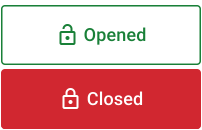
The Toggle button widget places a two-state button on any dashboard where each state has its own label, icon, and color. It reads the current device state on load — from an attribute, telemetry value, or RPC call — and sends an independent action for each state change. Use it when the two states have distinct, meaningful names — like Open/Closed, Active/Inactive, or Enabled/Disabled — and you want the button’s appearance to reflect exactly which state is currently set.
Key Capabilities
Section titled “Key Capabilities”- Two-state control (Checked/Unchecked) for any device or entity.
- Reads current device state on load from an attribute, telemetry value, or RPC call.
- Sends RPC commands, attribute updates, or telemetry writes independently for each state change.
- Independent styling for Checked and Unchecked states.
- Can be disabled automatically based on device data, alarms, or dashboard state.
Adding the Widget
Section titled “Adding the Widget”- Open the dashboard in edit mode. Click Add widget in the top toolbar, or click the Add new widget icon in the center of an empty dashboard.
- In the widget bundle selection dialog, find and click Buttons.
- Select the Toggle button widget.
- Configure the datasource, behavior, and appearance, then click Add.
Configuration
Section titled “Configuration”All settings in this section use Basic mode — a quick-start configuration covering the essentials. For finer widget controls like card style, card buttons, title, and tooltip, switch to the Advanced tab.
Datasource
Section titled “Datasource”Select the datasource for the widget:
- Device — a specific device; the button reads attribute and telemetry data from this device to determine its state.
- Entity alias — a set of entities matched by an entity alias; use this when the target device is selected dynamically at runtime.
Behavior
Section titled “Behavior”The Behavior section defines how the toggle reads its initial state, what fires when it switches to Checked, what fires when it switches to Unchecked, and when it disables. Configure each sub-section as needed; Disabled state is optional.
Initial State
Section titled “Initial State”Determines whether the toggle shows as Checked or Unchecked when the dashboard loads. Select one action type from the list below.
-
Do nothing
The state is set manually. No live data needed.
Parameter Description Value Set to Checked to always show the button as on, or Unchecked to always show it as off. -
Execute RPC
Calls a device RPC method to read the current state.
Parameter Description Method The RPC method name to call, like getState.Condition (None) Checked when the RPC result equals the value you specify. Condition (Function) Checked when your f(data)function returnstrue. -
Get attribute
Reads a device or entity attribute to determine the current state.
Parameter Description Attribute scope Where the attribute is stored: Any, Client, Server, or Shared. Attribute key The attribute name to read, like stateorenabled.Condition (None) Checked when the attribute equals the value you specify. Condition (Function) Checked when your f(data)function returnstrue. -
Get time series
Reads the latest telemetry value to determine the current state.
Parameter Description Time series key The telemetry key to monitor, like stateorpower.Condition (None) Checked when the telemetry value equals the value you specify. Condition (Function) Checked when your f(data)function returnstrue. -
Get alarm status
Sets the toggle to Checked when a matching alarm is currently active on the entity.
Parameter Description Alarm severity Which severity levels trigger the Checked state: Critical, Major, Minor, Warning, or Indeterminate. Alarm types Any alarm, or a specific alarm type. -
Get dashboard state id
Sets the toggle based on the currently open dashboard state; use this when button state should reflect navigation context.
Parameter Description Condition (None) Checked when the current state name matches the text you enter. Condition (Function) Checked when your f(data)function returnstrue. -
Get dashboard state object
Sets the toggle based on the full dashboard state context; use this when you need to check multiple state parameters at once.
Parameter Description Condition (Function only) Write a f(data)function that returnstrueto set the toggle to Checked.
Check (ON State)
Section titled “Check (ON State)”Defines the action executed when the user toggles the button to Checked, like turning on a device, opening a door, or starting a process. Select one action type from the list below.
-
Execute RPC
Sends an RPC command to the device when checked.
Parameter Description Method The RPC method name, like setState.Parameters Constant — a fixed value like true,"ON", or{"state": 1}; Function — a JS function that returns the payload; None — no parameters sent.RPC request timeout (ms) How long to wait for a device response before timing out. RPC request persistent When enabled, the RPC command is stored and retried until the device comes online. -
Set attribute
Updates a device attribute when checked.
Parameter Description Attribute scope Server or Shared. Attribute key The attribute to update, like stateordoorState.Value Constant — a fixed value like "opened"ortrue; Function — a JS function that returns the value. -
Add time series
Writes a time-series record when checked.
Parameter Description Time series key The telemetry key to write to, like state.Value Constant — a fixed value; Function — a JS function that returns the value.
Uncheck (OFF State)
Section titled “Uncheck (OFF State)”Defines the action executed when the user toggles the button to Unchecked, like turning off a device, closing a door, or stopping a process. Configure this as the reverse of Check. Select one action type from the list below.
-
Execute RPC
Sends an RPC command to the device when unchecked.
Parameter Description Method The RPC method name, like setState.Parameters Constant — a fixed value like false,"OFF", or{"state": 0}; Function — a JS function that returns the payload; None — no parameters sent.RPC request timeout (ms) How long to wait for a device response before timing out. RPC request persistent When enabled, the RPC command is stored and retried until the device comes online. -
Set attribute
Updates a device attribute when unchecked.
Parameter Description Attribute scope Server or Shared. Attribute key The attribute to update, like stateordoorState.Value Constant — a fixed value like "closed"orfalse; Function — a JS function that returns the value. -
Add time series
Writes a time-series record when unchecked.
Parameter Description Time series key The telemetry key to write to, like state.Value Constant — a fixed value; Function — a JS function that returns the value.
Disabled State
Section titled “Disabled State”The Disabled state makes the button non-interactive when a configured condition is met, preventing clicks in unsafe or invalid situations.
-
Do nothing
Set the disabled state manually. No live data needed.
Parameter Description Value Set to True to always disable the button, or False to always keep it enabled. -
Execute RPC
Disable the button based on a device RPC response, like checking availability before allowing control.
Parameter Description Method The RPC method to call, like getAvailability.Condition (None) Disabled when the RPC result equals the value you specify. Condition (Function) Disabled when your f(data)function returnstrue. -
Get attribute
Disable the button based on a device attribute, like an
onlinestatus or alockedflag.Parameter Description Attribute scope Where the attribute is stored: Any, Client, Server, or Shared. Attribute key The attribute name to read, like onlineorlocked.Condition (None) Disabled when the attribute equals the value you specify (String, Integer, Double, Boolean, or JSON). Condition (Function) Disabled when your f(data)function returnstrue. -
Get time series
Disable the button based on the latest telemetry value, like an operational mode or availability reading.
Parameter Description Time series key The telemetry key to monitor, like availabilityorstate.Condition (None) Disabled when the telemetry value equals the value you specify. Condition (Function) Disabled when your f(data)function returnstrue. -
Get alarm status
Disable the button while a specific alarm is active, like blocking control while a Critical alarm is open.
Parameter Description Alarm severity Critical, Major, Minor, Warning, or Indeterminate. Alarm types Any alarm, or a specific alarm type. -
Get dashboard state id
Disable the button based on the currently open dashboard state; use this to prevent actions in read-only or restricted views.
Parameter Description Condition (None) Disabled when the current state name matches the text you enter. Condition (Function) Disabled when your f(data)function returnstrue. -
Get dashboard state object
Disable the button using the full dashboard state context; use this when you need to check multiple state parameters at once.
Parameter Description Condition (Function only) Write a f(data)function that returnstrueto disable the button.
Appearance
Section titled “Appearance”Controls the widget header and title area.
| Setting | Description |
|---|---|
| Auto scale | Automatically adjusts font size and element proportions when the widget is resized. |
| Title | Text displayed in the widget header. Supports entity variables: $\{entityName\}, $\{entityLabel\}. |
| Card icon | Material Design icon shown alongside the title. Configurable size (px). |
Button Appearance
Section titled “Button Appearance”Controls the button’s visual style independently for each state. The section has two tabs: Checked (ON state) and Unchecked (OFF state).
| Setting | Description |
|---|---|
| Layout | Button visual style: Outlined (bordered), Filled (solid fill), Underlined (underline only), or Basic (plain text). |
| Label | Text displayed on the button in this state. Supports entity variables: $\{entityName\}, $\{entityLabel\}. |
| Icon | Material Design icon shown on the button. Configurable size (px). |
| Border radius | Roundness of button corners (px). |
| Color palette | Main: button fill or text color; Background: surrounding area color. |
| Custom styles | Per-interaction style overrides: Enabled, Hovered, Pressed, Activated, Disabled. Each supports Main, Background, and Shadow settings. |
Card Appearance
Section titled “Card Appearance”| Setting | Description |
|---|---|
| Background | Solid color or image used as the card background. |
| Show card buttons | Toggle visibility of the Fullscreen button in the card header. |
| Card border radius | Roundness of card corners. |
| Card padding | Spacing between card content and its border. |
Actions
Section titled “Actions”The Toggle button widget supports the Widget header button action — adds a button to the widget header that triggers a configured action when clicked.
Example
Section titled “Example”Door Open/Close Control
Section titled “Door Open/Close Control”Scenario: A smart supermarket has a device called Main Door that controls a door. The device reads its state from the shared attribute doorState and expects attribute updates to open or close the door.
Prerequisites:
- Create a device named Main Door in ThingsBoard.
- Add a shared attribute: Key —
doorState, Data type — String, Value —closed. - Ensure the device subscribes to
doorStateshared attribute updates.
Step 1. Add the widget. Open your dashboard in edit mode, click Add widget, select the Buttons bundle, then choose Toggle button.
Step 2. Configure the datasource. Set Target device to Main Door.
Step 3. Configure behavior.
Initial state: Get attribute — Scope: Shared, Key: doorState, Condition: None — Checked when result is opened (String).
Check (ON state): Set attribute — Scope: Shared, Key: doorState, Value: Constant — opened (String).
Uncheck (OFF state): Set attribute — Scope: Shared, Key: doorState, Value: Constant — closed (String).
Step 4. Configure button appearance.
Checked tab: Layout — Outlined, Label — Opened, Color palette Main — green.
Unchecked tab: Layout — Filled, Label — Closed, Color palette Main — red.
Step 5. Configure card appearance. Set Card padding to 0px.
Step 6. Save. Click Add, resize and reposition as needed, then click Save on the dashboard toolbar.
Result: The widget reads doorState from Main Door. When doorState = "opened", the button shows Opened (white background, green label); when doorState = "closed", it shows Closed (red fill). Toggling the button writes the new value to doorState — the device receives the update and adjusts its physical state.
Troubleshooting
Section titled “Troubleshooting”Toggle Does Not Reflect the Expected State
| Cause | Solution |
|---|---|
| Incorrect attribute key | Verify the key matches the device attribute exactly. Key names are case-sensitive. |
| Wrong attribute scope | Match the scope to the actual attribute type (Client / Server / Shared). |
| No attribute on device | Open Devices → Attributes and confirm the key exists with a value. |
| Result converter always returns the same value | Review the Function converter; check for a missing return statement or incorrect comparison. |
Toggle Does Not Change State on Click
| Cause | Solution |
|---|---|
| Check or Uncheck action misconfigured | Confirm the action type and parameters match your device’s expected interface (RPC method name, attribute key, etc.). |
| Attribute scope mismatch | For Set attribute actions, the scope must be Server or Shared — Client attributes cannot be written from the dashboard. |
| Device offline during RPC | If using Execute RPC without persistent mode, the command is dropped when the device is offline. Enable RPC request persistent to queue it. |
| Wrong value type | Ensure the constant value type (String, Boolean, Integer) matches what the device expects. |
Was this helpful?