HP Simple Horizontal Scale
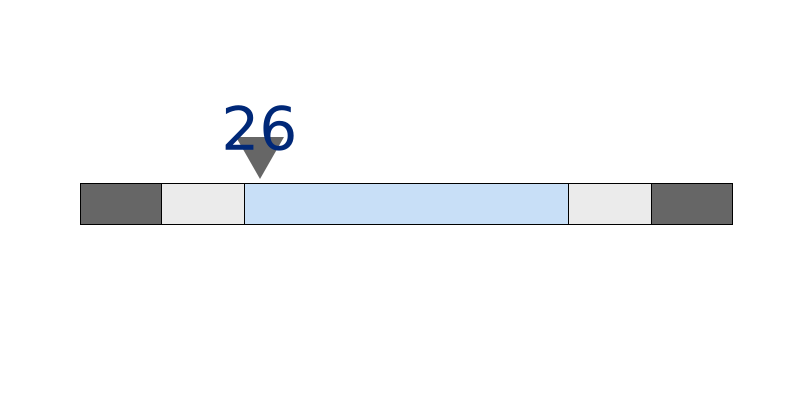
The HP Simple horizontal scale widget renders a horizontal scale bar with an arrow pointer that tracks the current measured value within a defined range. Warning and critical threshold zones are set directly in the widget’s Appearance settings, making them simple to configure when operational limits are fixed and the same for all devices. An optional target marker shows a setpoint or reference value on the same scale.
Use it to monitor temperature, pressure, humidity, flow rate, volume, or any continuous sensor reading in HVAC, water treatment, industrial automation, or building management systems where threshold limits are uniform across devices and a compact horizontal gauge fits the diagram layout. When thresholds vary per device and need to be read from device attributes, use the HP Dynamic horizontal scale instead.
Key Capabilities
Section titled “Key Capabilities”- Display a live sensor value as a pointer position on a horizontal scale.
- Define high critical, high warning, low warning, and low critical threshold bands.
- Optionally show a target or setpoint marker on the scale.
- Configure the scale range, value label, units, and decimal precision.
- Set independent colors for the scale, warning zones, and critical zones.
- Trigger a dashboard action when the widget symbol is clicked.
- Receive state data from device attributes, time series, alarm status, or dashboard state.
Add the Widget
Section titled “Add the Widget”- Open the dashboard and switch to edit mode.
- Click Add widget at the top, or the Add new widget icon in the center of the screen.
- Open the General high-performance SCADA symbols widget bundle.
- Select HP Simple horizontal scale.
- Configure the widget settings, then click Add.
Target Device
Section titled “Target Device”The widget connects to a single data source: either a Device or an Entity alias that resolves to a device. This device provides the telemetry or attribute values used to drive the widget’s visual state.
SCADA Symbol
Section titled “SCADA Symbol”The SCADA symbol defines the visual shape of the widget. The HP Simple horizontal scale widget has a pre-selected symbol from the General high-performance SCADA symbols bundle. To use a different symbol, click Browse SCADA symbol from gallery and choose one from the library, or upload your own.
Behavior
Section titled “Behavior”Behavior parameters define what the widget displays and how it responds to user interaction, driven by real-time data from the connected device.
| Parameter | Default | Description |
|---|---|---|
| Value | Use time series 'temperature' |
The current sensor reading. The arrow pointer moves to the position on the scale that corresponds to this value. See Data source configuration. |
| Target value | Use attribute 'target' |
Optional reference or setpoint value. When configured, a second marker appears on the scale at this position. See Data source configuration. |
| On click | Do nothing |
Action triggered when the user clicks the widget symbol. See Click action configuration. |
Click Action Configuration
Section titled “Click Action Configuration”Applies to On click. Select one action type from the list below.
-
Do nothing
The symbol is clickable but performs no action. Use while testing styles or as a placeholder.
-
Navigate to new dashboard state
Switches to a different view within the same dashboard, like opening a sensor details screen.
Parameter Description Target dashboard state The state to open (required). Open right dashboard layout (mobile view) Opens a side panel instead of replacing the view (mobile only). Set entity from widget Passes the current entity to the target state. State entity parameter name The key the entity is passed under. Dashboard state display option Normal (same view), In separate dialog (popup), or In popover (inline overlay). -
Update current dashboard state
Updates the context of the current view, like switching the selected device, without navigating away.
Parameter Description Target dashboard state The state to switch to (optional). Open right dashboard layout (mobile view) Opens a side panel on mobile. Set entity from widget Passes the current entity to the updated state. State entity parameter name The key the entity is passed under. -
Navigate to other dashboard
Opens a completely different dashboard, like jumping from this system view to a global overview.
Parameter Description Target dashboard The dashboard to open (required). Target dashboard state The specific view to open within that dashboard. Open in a new browser tab Opens the dashboard without leaving the current page. Set entity from widget Passes the current entity to the other dashboard. State entity parameter name The key the entity is passed under. -
Custom action
Runs custom JavaScript on click to implement any behavior not covered by the built-in options. Use it to make HTTP requests, open custom dialogs, call other widget APIs, or interact with external services. The function receives:
$event,widgetContext,entityId,entityName,additionalParams,entityLabel. -
Custom action (with HTML template)
Same as Custom action, but also renders a custom HTML panel or dialog when the symbol is clicked. The function receives an additional
htmlTemplateparameter:$event,widgetContext,entityId,entityName,htmlTemplate,additionalParams,entityLabel.Parameter Description Resources External scripts and styles loaded before the action runs. CSS Styling for the HTML template. HTML Layout of the rendered dialog or panel. JS Action logic. -
Mobile action
Triggers a native device feature inside a ThingsBoard mobile app, like the camera or QR scanner.
Parameter Description Mobile action type Take picture from gallery, Take photo, Open map directions, Open map location, Scan QR Code, Make phone call, Get phone location, Take screenshot, or Device provision. -
Open URL
Opens a website or external link when clicked.
Parameter Description URL The address to open (required). Open in a new browser tab Keeps the current dashboard open while opening the link.
Data Source Configuration
Section titled “Data Source Configuration”Applies to Value and Target value. Click the edit icon next to a parameter to open its configuration dialog. When Action is set to Do nothing, the value is a fixed number:
| Parameter | Value |
|---|---|
| Value | Numeric value to display statically on the scale |
| Target value | Numeric value to use as a fixed target marker |
For all other actions, the configuration dialog works the same way regardless of which parameter you are editing:
-
Execute RPC
Read the parameter value from an RPC response.
Parameter Description Method RPC method to call, like getTemperatureorgetTarget.Action result converter None — uses the result value directly; Function — returns the value from your f(data)function.RPC request timeout (ms) How long to wait for a device response before timing out (Advanced settings). RPC request persistent Stores and retries the command until the device comes online (Advanced settings). -
Get attribute
Read the parameter value from a device attribute.
Parameter Description Attribute scope Where the attribute is stored: Any, Client, Server, or Shared. Attribute key Attribute name to read, like target.Action result converter None — uses the attribute value directly; Function — returns the value from your f(data)function. -
Get time series
Read the parameter value from the latest telemetry reading.
Parameter Description Time series key Telemetry key to monitor, like temperature.Action result converter None — uses the telemetry value directly; Function — returns the value from your f(data)function. -
Get alarm status
Set the parameter value based on alarm activity on the device.
Parameter Description Alarm severity Which severity levels trigger the active state: Critical, Major, Minor, Warning, or Indeterminate. Alarm types Any alarm, or a specific alarm type. -
Get dashboard state id
Set the parameter value based on which dashboard state is currently open.
Parameter Description Action result converter None — uses the state name directly; Function — returns the value from your f(data)function. -
Get dashboard state object
Set the parameter value using the full dashboard state context; use this when you need to evaluate multiple state parameters at once.
Parameter Description Parse value function A f(data)function that receives the current dashboard state object. Usedata.idto read the active state name, ordata.paramsto inspect state parameters.
Appearance
Section titled “Appearance”The Appearance section controls the widget title, scale range, threshold positions, value display, label, units, and colors.
| Setting | Default | Description |
|---|---|---|
| Title | HP Simple horizontal scale |
Widget title displayed in the header. Supports entityName and entityLabel variables. |
| Card icon | — | Icon shown in the widget header. Configure its size and color. |
| Min and max value | Min: 0, Max: 100 |
The range of the scale. The pointer is positioned proportionally within this range. |
| High Critical scale | 85 |
Upper critical threshold. The scale zone above this value is colored with the critical color. |
| High Warning scale | 70 |
Upper warning threshold. The scale zone between this value and the high critical threshold is colored with the warning color. |
| Low Warning scale | 30 |
Lower warning threshold. The scale zone between the low critical threshold and this value is colored with the warning color. |
| Low Critical state | 15 |
Lower critical threshold. The scale zone below this value is colored with the critical color. |
| Value | On | Whether to display the numeric value on the widget. Configure decimal precision, font, and color. |
| Label | Outdoor |
Descriptive text label shown alongside the scale. Configure its font and color. |
| Units | °C |
Unit suffix shown on the scale. Configure its font and color. |
| Arrow color | Gray | Color of the pointer arrow indicating the current value position. |
| Target | Off | Whether to display the target marker on the scale. When enabled, configure its color. |
| Scale color | Light blue | Base color of the scale bar in the normal (non-threshold) zone. |
| Warning scale color | Default: Gray, Active: Orange | Colors for the warning zones: Default is used when the value is outside the zone, Active when the value is inside it. |
| Critical scale color | Default: Gray, Active: Red | Colors for the critical zones: Default is used when the value is outside the zone, Active when the value is inside it. |
Card Appearance
Section titled “Card Appearance”The Card appearance section controls the widget container style.
| Setting | Default | Description |
|---|---|---|
| Background | Transparent | Card background color. |
| Show card buttons | Fullscreen | Buttons shown on the card when hovered. |
| Card border radius | 0px |
Rounding of card corners. |
| Card padding | 12px |
Inner spacing between the card edge and widget content. |
Troubleshooting
Section titled “Troubleshooting”Pointer does not move or is always at zero
| Cause | Solution |
|---|---|
| Value action is Do nothing with a zero or missing value | Open the Value edit dialog and configure it to read from a device time series key or attribute. |
| Device is not sending telemetry | Confirm the device is online and publishing the expected time series key. |
Scale zones do not change color when the value enters a threshold
| Cause | Solution |
|---|---|
| Threshold values are outside the configured scale range | Confirm that High Critical scale, High Warning scale, Low Warning scale, and Low Critical state all fall within the Min and max value range. |
| Warning or critical zone is disabled | Check that the threshold toggles are enabled in the Appearance section. |
Target marker does not appear
| Cause | Solution |
|---|---|
| Target is disabled in Appearance | Enable the Target toggle in the Appearance section. |
| Target value action is Do nothing with a zero value | Open the Target value edit dialog and configure it to read from an attribute or time series key. |
Solution Templates
Section titled “Solution Templates”This widget is used in the following ready-made solution template built on the General high-performance SCADA symbols bundle:
- SCADA Swimming pool — a complete swimming pool monitoring dashboard that uses the HP Simple horizontal scale to display sensor readings such as temperature and pressure in context.
Was this helpful?