Actor System
ThingsBoard uses an actor-based concurrency model to manage per-entity state. Every device, rule chain, tenant, and calculated field gets its own actor — a lightweight object with a private mailbox. The actor processes messages one at a time, eliminating locks and race conditions. This design lets the platform handle millions of entities on a single node without shared mutable state.
How Actors Work
Section titled “How Actors Work”Each actor follows a simple lifecycle:
- Created on demand — when a message arrives for an entity (e.g., telemetry from device
ABC), the system creates an actor if one doesn’t exist. - Mailbox queuing — incoming messages land in the actor’s mailbox (an in-memory queue).
- Sequential processing — the actor processes messages one at a time, in order. No two threads ever execute inside the same actor simultaneously.
- Ephemeral state — actors may hold in-memory state (e.g., latest attribute values, active RPC requests), but this state is rebuilt from the database on restart. The database is always the source of truth.
Actor Hierarchy
Section titled “Actor Hierarchy”Actors are organized in a tree. Parent actors manage the lifecycle of their children:
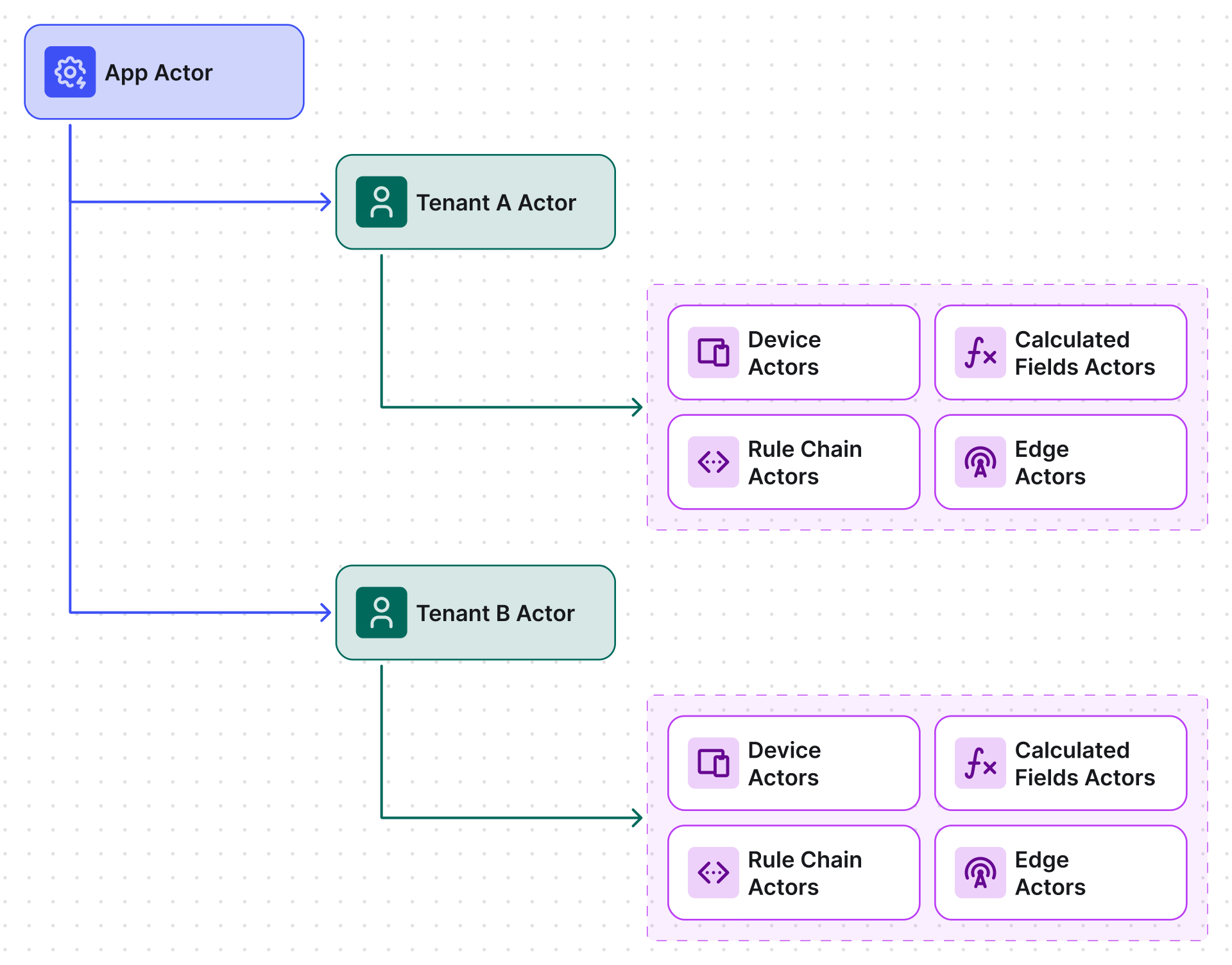
| Actor Type | One per | Responsibility |
|---|---|---|
| App | JVM | Root actor — creates and supervises tenant actors |
| Tenant | Tenant | Creates device, rule chain, and calculated field actors for the tenant |
| Device | Device | Handles device sessions, RPC, connectivity state, activity tracking |
| Rule Chain | Rule Chain | Manages rule node actors, routes messages through the rule chain |
| Rule Node | Rule Node | Executes a single rule node’s logic (filter, transform, action) |
| CF Manager | Tenant | Coordinates calculated field evaluation across entities |
| CF Engine | Calculated Field | Executes a single calculated field’s logic |
| Edge | Edge instance | Manages edge synchronization state |
Dispatcher Thread Pools
Section titled “Dispatcher Thread Pools”Each actor type runs on a dedicated thread pool (dispatcher). This prevents one type of work from starving another — a burst of device messages won’t block rule chain processing.
| Dispatcher | ENV Variable | Default | Handles |
|---|---|---|---|
| App | ACTORS_SYSTEM_APP_DISPATCHER_POOL_SIZE |
1 |
App actor only — lightweight |
| Tenant | ACTORS_SYSTEM_TENANT_DISPATCHER_POOL_SIZE |
2 |
Tenant actor message processing |
| Device | ACTORS_SYSTEM_DEVICE_DISPATCHER_POOL_SIZE |
4 |
Device sessions, RPC, state tracking |
| Rule Engine | ACTORS_SYSTEM_RULE_DISPATCHER_POOL_SIZE |
8 |
Rule chain and rule node execution |
| Edge | ACTORS_SYSTEM_EDGE_DISPATCHER_POOL_SIZE |
4 |
Edge synchronization |
| CF Manager | ACTORS_SYSTEM_CFM_DISPATCHER_POOL_SIZE |
2 |
Calculated field coordination |
| CF Engine | ACTORS_SYSTEM_CFE_DISPATCHER_POOL_SIZE |
8 |
Calculated field execution |
Throughput Setting
Section titled “Throughput Setting”ACTORS_SYSTEM_THROUGHPUT (default 5) controls how many messages an actor processes in a single batch before yielding the thread to other actors. This is the fairness knob:
- Low value (1–5) — each actor processes fewer messages per turn, giving all actors equal access to the thread pool. Better latency fairness when many actors are active.
- High value (25–50) — actors process more messages per turn, reducing context-switch overhead. Better throughput when a few actors receive heavy traffic.
For most deployments, the default of 5 provides a good balance. Increase it only if profiling shows excessive dispatcher scheduling overhead.
External Call Thread Pools
Section titled “External Call Thread Pools”Rule engine action nodes that perform I/O (database writes, HTTP calls, emails, SMS) execute on separate thread pools to avoid blocking the actor dispatchers:
| Thread Pool | ENV Variable | Default | Purpose |
|---|---|---|---|
| DB Callbacks | ACTORS_RULE_DB_CALLBACK_THREAD_POOL_SIZE |
50 |
Database write callbacks from rule engine nodes |
ACTORS_RULE_MAIL_THREAD_POOL_SIZE |
40 |
Email sending from “send email” rule nodes | |
| Password Reset Mail | ACTORS_RULE_MAIL_PASSWORD_RESET_THREAD_POOL_SIZE |
10 |
Password reset emails (separate pool to avoid blocking) |
| SMS | ACTORS_RULE_SMS_THREAD_POOL_SIZE |
50 |
SMS sending from “send SMS” rule nodes |
| External REST | ACTORS_RULE_EXTERNAL_CALL_THREAD_POOL_SIZE |
50 |
HTTP calls to external APIs from “rest api call” rule nodes |
| AI Requests | ACTORS_RULE_AI_REQUESTS_THREAD_POOL_SIZE |
50 |
AI/LLM API calls from AI rule nodes |
Session and Concurrency
Section titled “Session and Concurrency”ACTORS_MAX_CONCURRENT_SESSION_PER_DEVICE (default 1) limits how many simultaneous transport sessions a single device can have. The default of 1 means that when a device opens a new MQTT connection, any existing session for that device is closed.
Increase this value only if your devices legitimately maintain multiple concurrent connections (e.g., a gateway device with multiple sub-connections).
Rule Chain Error Handling
Section titled “Rule Chain Error Handling”The actor system tracks error rates in rule chains and rule nodes:
ACTORS_RULE_CHAIN_ERROR_FREQUENCY(default3000ms) — minimum interval between error log entries for the same rule chain. Prevents log flooding when a misconfigured rule chain fails on every message.ACTORS_RULE_NODE_ERROR_FREQUENCY(default3000ms) — same, per rule node.ACTORS_RULE_CHAIN_DEBUG_MODE_RATE_LIMITS_PER_TENANT_ENABLED(defaulttrue) — enables per-tenant rate limiting in debug mode.ACTORS_RULE_CHAIN_DEBUG_MODE_RATE_LIMITS_PER_TENANT_CONFIGURATION(default50000:3600) — maximum 50,000 debug events per tenant per hour.
Tuning Recommendations
Section titled “Tuning Recommendations”| Workload | What to scale | Why |
|---|---|---|
| High device count, frequent telemetry | ACTORS_SYSTEM_DEVICE_DISPATCHER_POOL_SIZE |
More threads to handle device actor mailboxes |
| Complex rule chains, many rule nodes | ACTORS_SYSTEM_RULE_DISPATCHER_POOL_SIZE |
Rule chain processing is CPU-bound |
| Many external API calls from rules | ACTORS_RULE_EXTERNAL_CALL_THREAD_POOL_SIZE |
I/O-bound; threads block waiting for HTTP responses |
| Heavy database writes from rules | ACTORS_RULE_DB_CALLBACK_THREAD_POOL_SIZE |
Write callbacks queue when DB is slow |
| Many calculated fields | ACTORS_SYSTEM_CFE_DISPATCHER_POOL_SIZE |
CF evaluation is CPU-bound |
| High email/SMS volume | ACTORS_RULE_MAIL_THREAD_POOL_SIZE, ACTORS_RULE_SMS_THREAD_POOL_SIZE |
I/O-bound, limited by provider API rate limits |
For the complete list of actor system environment variables, see Configuration Reference.
Was this helpful?