Alarm Count
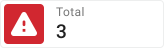
The Alarm count widget displays a live count of alarms matching a set of filter criteria — status, severity, type, or assignee. Use it to surface alarm KPIs on any monitoring dashboard: total active alarms across the system, unacknowledged criticals for a device group, or alarms assigned to a specific operator.
Key Capabilities
Section titled “Key Capabilities”- Count alarms system-wide or scoped to a specific device or entity alias.
- Filter by status, severity, type, and assignee — filters can be combined.
- Two layout options: vertical (Column) or horizontal (Row).
- Configurable icon, label, and color to communicate severity at a glance.
- Optional chevron indicator and On card click action to navigate to a details view on click.
- Propagated alarm support: child entity alarms can be included in the count.
Adding the Widget
Section titled “Adding the Widget”- In dashboard edit mode, click Add widget in the top toolbar, or click the Add new widget icon in the center of an empty dashboard.
- In the widget bundle selection dialog, find and click Alarm widgets.
- Select the Alarm count widget.
- Configure the datasource, filters, and appearance, then click Add.
Configuration
Section titled “Configuration”All settings in this section use Basic mode — a quick-start configuration covering the essentials. For finer widget controls like title font, card style, and tooltip, switch to the Advanced tab.
Datasource
Section titled “Datasource”Select the entity or alias whose alarms will be counted:
- Device — a specific device; counts only alarms originating from this device.
- Entity alias — a set of entities matched by an entity alias; use this to count alarms across multiple devices or assets at once.
If no datasource is configured, the widget counts alarms across all entities in the system, filtered by the criteria below.
Filter
Section titled “Filter”The Filter section controls which alarms are included in the count. Multiple criteria can be combined.
| Filter | Description |
|---|---|
| Alarm status list | Count only alarms with the selected statuses: Active, Cleared, Acknowledged, Unacknowledged. |
| Alarm severity list | Count only alarms at the selected severity levels: Critical, Major, Minor, Warning, Indeterminate. |
| Alarm type list | Restrict count to selected alarm types, like High temperature or Device offline. The list is populated from alarm types present in the system. |
| Assignee | Count only alarms assigned to a specific user. |
| Search propagated alarms | When enabled, includes alarms propagated from child entities, like a device alarm surfacing on its parent asset. |
Appearance
Section titled “Appearance”Controls the widget layout, label, and visual style.
| Setting | Description |
|---|---|
| Layout | Column — stacks icon, value, and label vertically. Row — places icon and value side by side. |
| Auto scale | Automatically adjusts font sizes to fit the widget area when resized. |
| Label | Descriptive text shown on the card, like Total, Active, or Critical. |
| Icon | Icon representing the alarm category, with configurable size and color. |
| Icon background | Background color behind the icon. Use to communicate severity at a glance, like red for Critical or orange for Major. |
| Value | Font and color for the displayed count number. |
| Chevron | Adds a chevron (›) next to the value to indicate the card is clickable. Pair with an On card click action. |
Card Appearance
Section titled “Card Appearance”| Setting | Description |
|---|---|
| Background | Card background color, gradient, or transparency. |
| Show card buttons | Toggle Data export and Fullscreen buttons in the widget header. |
| Card border radius | Roundness of card corners. |
Actions
Section titled “Actions”The Alarm count widget supports the following action sources:
- On card click — triggered when the user clicks anywhere on the widget card. Enable Chevron in the appearance settings to provide a visual click indicator.
- Widget header button — adds a custom button to the widget header bar.
Examples
Section titled “Examples”Active Alarms Counter
Section titled “Active Alarms Counter”Goal: Display the total number of currently active alarms across all entities in the system.
Step 1. Add the widget. Open the dashboard in edit mode, click Add widget, select Alarm widgets, then choose Alarm count.
Step 2. Leave the datasource empty to count alarms across all entities system-wide.
Step 3. Configure the filter. Set Alarm status list to Active.
Step 4. Configure appearance. Set the Label to Active.
Step 5. Save. Click Add, resize as needed, then click Save on the dashboard toolbar.
Result: The widget displays the live count of active alarms and updates automatically as alarm states change.
Active Critical Alarms for a Device Type
Section titled “Active Critical Alarms for a Device Type”Goal: Show the number of active Critical alarms for all devices of the smart sensor type.
Step 1. Add the widget. Open the dashboard in edit mode, click Add widget, select Alarm widgets, then choose Alarm count.
Step 2. Configure the datasource. Set Entity alias — create or select an alias with Filter type: Device type → smart sensor.
Step 3. Configure the filter. Set Alarm status list to Active and Alarm severity list to Critical.
Step 4. Configure appearance. Set Layout to Row and Label to Critical.
Step 5. Save. Click Add, resize as needed, then click Save on the dashboard toolbar.
Result: The widget shows a live count of active Critical alarms from all smart sensor devices, updated automatically as alarms are raised or cleared.
Troubleshooting
Section titled “Troubleshooting”Widget Shows Zero or No Count
| Cause | Solution |
|---|---|
| Filter excludes all alarms | Check Alarm status list and Alarm severity list — if set, only matching alarms are counted. Clear filters to confirm alarms exist. |
| Datasource alias resolves to no entities | Open Entity aliases in the dashboard and verify the alias returns results. |
| No alarm rules defined | Verify the device profile has alarm rules configured and that alarms have been triggered. |
| Propagated alarms not counted | Enable Search propagated alarms to include alarms from child entities. |
Widget Fails to Load, or the Count Stops Updating
| Cause | Solution |
|---|---|
| Alarm history has grown large | The widget has no time window, so it counts across the whole alarm history — with many entities, the count can time out against a large alarm table. On the widget’s first load this appears as a connection error; if the same timeout happens on a later refresh instead, it fails silently and the displayed count simply stops updating. Narrow the datasource, severity, or type filters, or set Alarms TTL days in the Tenant profile Data Retention settings to bound alarm history growth. |
Was this helpful?