HP Top Tee Connector
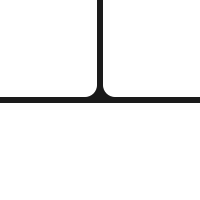
The HP Top tee connector widget renders a T-shaped connector with openings on the left, top, and right — a horizontal run with an upward branch. Each arm carries its own animated fluid flow stripe that can be shown or hidden and controlled in direction and speed from live device data.
Use it wherever a main horizontal pipeline splits off an upward branch — for example, routing a horizontal supply line to an elevated tank, heat exchanger, or vent — in HVAC, water treatment, industrial automation, or building management systems.
Key Capabilities
Section titled “Key Capabilities”- Display a T-shaped connector with openings at the left, top, and right.
- Independently show or hide an animated fluid flow stripe on each arm (left, top, right) based on device state.
- Control the flow direction (forward or reverse) on each arm from live device data.
- Control the flow animation speed on each arm from live device data.
- Receive state data from device attributes, time series, alarm status, or dashboard state.
Add the Widget
Section titled “Add the Widget”- Open the dashboard and switch to edit mode.
- Click Add widget at the top, or the Add new widget icon in the center of the screen.
- Open the General high-performance SCADA symbols widget bundle.
- Select HP Top tee connector.
- Configure the widget settings, then click Add.
Target Device
Section titled “Target Device”The widget connects to a single data source: either a Device or an Entity alias that resolves to a device. This device provides the attribute or telemetry values used to drive the widget’s visual state.
SCADA Symbol
Section titled “SCADA Symbol”The SCADA symbol defines the visual shape of the widget. The HP Top tee connector widget has a pre-selected symbol from the General high-performance SCADA symbols bundle. To use a different symbol, click Browse SCADA symbol from gallery and choose one from the library, or upload your own.
Behavior
Section titled “Behavior”Behavior parameters define what the widget displays, driven by real-time data from the connected device. The three arms — Left connector, Top connector, and Right connector — are configured independently. Each arm has the same three parameters.
Left Connector
Section titled “Left Connector”| Parameter | Default | Description |
|---|---|---|
| Flow presence | Absent |
Whether the animated fluid flow stripe is shown on the left arm. See Presence and direction configuration. |
| Flow direction | Forward |
Direction of the animated flow on the left arm. See Presence and direction configuration. |
| Flow animation speed | 1 |
Speed of the flow animation on the left arm. 1 is normal speed; 0 disables animation; values above 1 slow the animation; values below 1 speed it up. See Flow animation speed configuration. |
Top Connector
Section titled “Top Connector”| Parameter | Default | Description |
|---|---|---|
| Flow presence | Absent |
Whether the animated fluid flow stripe is shown on the top arm. See Presence and direction configuration. |
| Flow direction | Forward |
Direction of the animated flow on the top arm. See Presence and direction configuration. |
| Flow animation speed | 1 |
Speed of the flow animation on the top arm. See Flow animation speed configuration. |
Right Connector
Section titled “Right Connector”| Parameter | Default | Description |
|---|---|---|
| Flow presence | Absent |
Whether the animated fluid flow stripe is shown on the right arm. See Presence and direction configuration. |
| Flow direction | Forward |
Direction of the animated flow on the right arm. See Presence and direction configuration. |
| Flow animation speed | 1 |
Speed of the flow animation on the right arm. See Flow animation speed configuration. |
Presence and Direction Configuration
Section titled “Presence and Direction Configuration”Applies to Flow presence and Flow direction on each arm. Click the edit icon next to a parameter to open its configuration dialog. When Action is set to Do nothing, select a fixed value:
| Parameter | Value |
|---|---|
| Flow presence | Present or Absent |
| Flow direction | Forward or Reverse |
For all other actions, the configuration dialog includes these options:
-
Execute RPC
Read the parameter value from an RPC response.
Parameter Description Method RPC method to call, like getFlowState.Action result converter None — parameter is activated when the result matches the value you specify; Function — parameter is activated when your f(data)returnstrue.‘Present’/‘Forward’ when result is The value or condition that activates the present or forward state. RPC request timeout (ms) How long to wait for a device response before timing out (Advanced settings). RPC request persistent Stores and retries the command until the device comes online (Advanced settings). -
Get attribute
Read the parameter value from a device attribute.
Parameter Description Attribute scope Where the attribute is stored: Any, Client, Server, or Shared. Attribute key Attribute name to read, like flowPresentorflowDirection.Action result converter None — parameter is activated when the attribute equals the value you specify; Function — parameter is activated when your f(data)returnstrue.‘Present’/‘Forward’ when result is The value or condition that activates the present or forward state. -
Get time series
Read the parameter value from the latest telemetry reading.
Parameter Description Time series key Telemetry key to monitor, like flowPresent.Action result converter None — parameter is activated when the telemetry value equals what you specify; Function — parameter is activated when your f(data)returnstrue.‘Present’/‘Forward’ when result is The value or condition that activates the present or forward state. -
Get alarm status
Activate the present or forward state when a specific alarm is active on the device.
Parameter Description Alarm severity Which severity levels trigger the active state: Critical, Major, Minor, Warning, or Indeterminate. Alarm types Any alarm, or a specific alarm type. -
Get dashboard state id
Activate the present or forward state based on which dashboard state is currently open.
Parameter Description Action result converter None — parameter is activated when the state name matches the text you enter; Function — parameter is activated when your f(data)returnstrue.‘Present’/‘Forward’ when result is The state name or condition that activates the present or forward state. -
Get dashboard state object
Activate the present or forward state using the full dashboard state context; use this when you need to evaluate multiple state parameters at once.
Parameter Description Parse value function A f(data)function that receives the current dashboard state object. Usedata.idto read the active state name, ordata.paramsto inspect state parameters.‘Present’/‘Forward’ when result is The expected type and value that activates the present or forward state. Choose String, Integer, Double, Boolean (then select True or False), or JSON.
Flow Animation Speed Configuration
Section titled “Flow Animation Speed Configuration”Applies to Flow animation speed on each arm. Click the edit icon next to the parameter to open its configuration dialog. When Action is set to Do nothing, enter a fixed numeric speed value.
For all other actions, the configuration dialog works the same way:
-
Execute RPC
Read the speed value from an RPC response.
Parameter Description Method RPC method to call, like getFlowSpeed.Action result converter None — uses the result value directly; Function — returns the value from your f(data)function.RPC request timeout (ms) How long to wait for a device response before timing out (Advanced settings). RPC request persistent Stores and retries the command until the device comes online (Advanced settings). -
Get attribute
Read the speed value from a device attribute.
Parameter Description Attribute scope Where the attribute is stored: Any, Client, Server, or Shared. Attribute key Attribute name to read, like flowSpeed.Action result converter None — uses the attribute value directly; Function — returns the value from your f(data)function. -
Get time series
Read the speed value from the latest telemetry reading.
Parameter Description Time series key Telemetry key to monitor, like flowSpeed.Action result converter None — uses the telemetry value directly; Function — returns the value from your f(data)function. -
Get alarm status
Set the speed value based on alarm activity on the device.
Parameter Description Alarm severity Which severity levels trigger the active state: Critical, Major, Minor, Warning, or Indeterminate. Alarm types Any alarm, or a specific alarm type. -
Get dashboard state id
Set the speed value based on which dashboard state is currently open.
Parameter Description Action result converter None — uses the state name directly; Function — returns the value from your f(data)function. -
Get dashboard state object
Set the speed value using the full dashboard state context; use this when you need to evaluate multiple state parameters at once.
Parameter Description Parse value function A f(data)function that receives the current dashboard state object. Usedata.idto read the active state name, ordata.paramsto inspect state parameters.
Appearance
Section titled “Appearance”The Appearance section controls the widget title, the connector line style, and the flow animation stripe style.
| Setting | Default | Description |
|---|---|---|
| Title | HP Top tee connector |
Widget title displayed in the header. Supports entityName and entityLabel variables. |
| Card icon | — | Icon shown in the widget header. Configure its size and color. |
| Line | 6 px, black |
Thickness and color of the main connector line. |
Flow subsection — controls the appearance of the animated fluid flow stripe on all arms:
| Setting | Default | Description |
|---|---|---|
| Line | 4 px, light blue |
Thickness and color of the flow animation stripe. |
| Line style | Dash 10 px, Gap 10 px |
Dash and gap lengths of the flow stripe. For smooth looping, use values that divide evenly into 100. |
| Dash cap | Butt |
End cap style for each dash segment: Butt (flat), Round (rounded ends), or Square (flat with half-width extension). |
Card Appearance
Section titled “Card Appearance”The Card appearance section controls the widget container style.
| Setting | Default | Description |
|---|---|---|
| Background | Transparent | Card background color. |
| Show card buttons | Fullscreen | Buttons shown on the card when hovered. |
| Card border radius | 0px |
Rounding of card corners. |
| Card padding | 12px |
Inner spacing between the card edge and widget content. |
Troubleshooting
Section titled “Troubleshooting”Flow animation does not run on an arm
| Cause | Solution |
|---|---|
| Flow presence for that arm is Do nothing with value set to Absent | Open the Flow presence edit dialog for the affected arm and set the value to Present, or configure it to read from a device attribute or time series key. |
Flow animation speed for that arm is 0 |
Open the Flow animation speed edit dialog for the affected arm and set a non-zero value. |
Flow animation runs in the wrong direction on an arm
| Cause | Solution |
|---|---|
| Flow direction for that arm is set to the opposite value | Open the Flow direction edit dialog for the affected arm and switch between Forward and Reverse, or configure it to read the direction from a device attribute or time series key. |
Solution Templates
Section titled “Solution Templates”This widget is used in the following ready-made solution template built on the General high-performance SCADA symbols bundle:
- SCADA Swimming pool — a complete swimming pool monitoring dashboard that uses the HP Top tee connector to represent branching flow paths between diagram elements.
Was this helpful?