Digital Twin Entities
ThingsBoard models the physical world as a graph of entities connected by relations. Every entity supports attributes, time-series data, and alarm rules — giving you a unified way to represent, monitor, and control your IoT infrastructure.
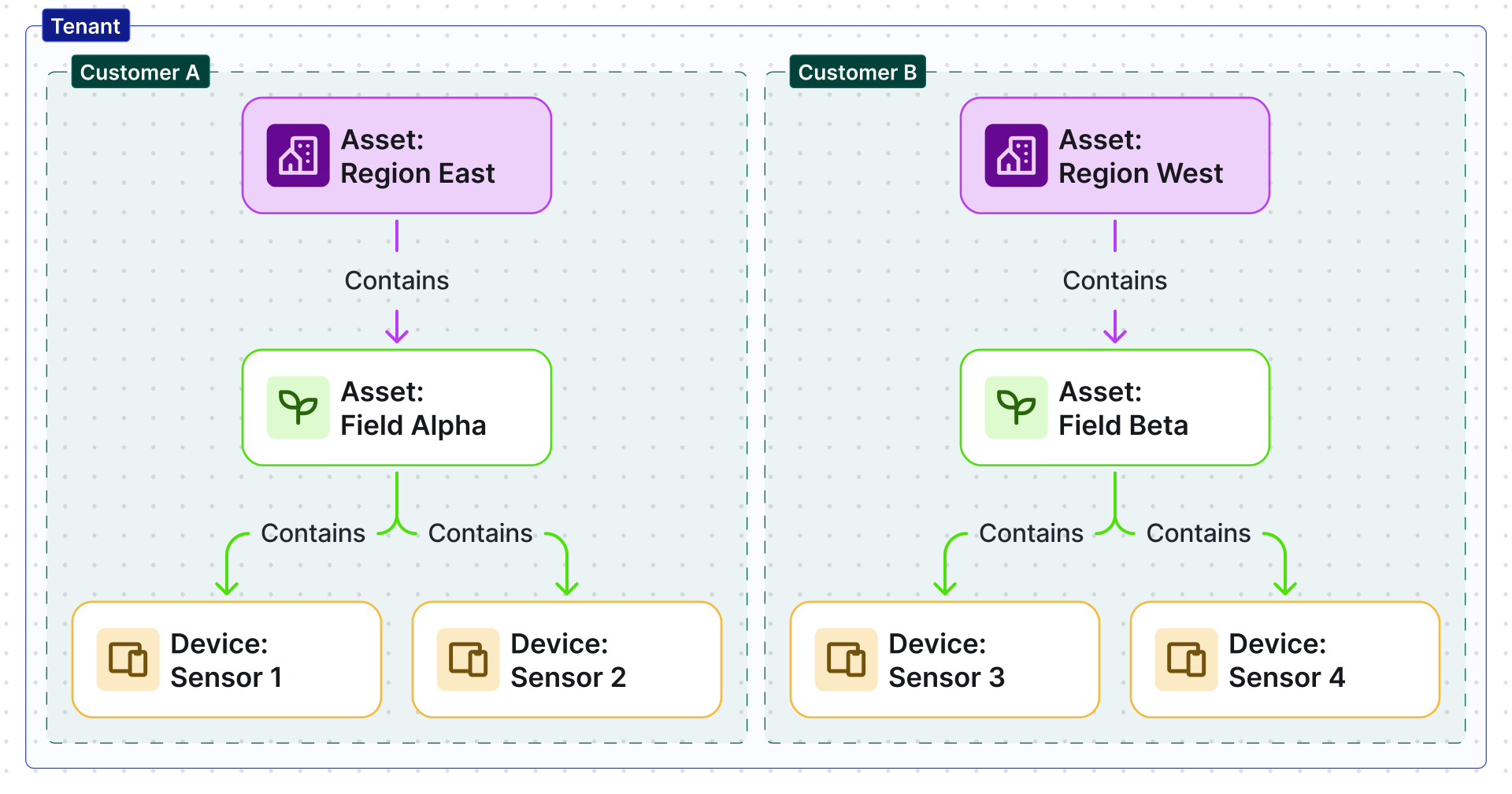
Core Entities
Section titled “Core Entities”| Entity | Purpose |
|---|---|
| Tenant | Top-level business entity that owns all other entities |
| Customer | Organization or individual that uses tenant devices and assets |
| User | Person who logs in to browse dashboards and manage entities |
| Device | Physical or virtual thing that publishes telemetry and handles RPC commands |
| Asset | Abstract object (building, field, vehicle) used to group and aggregate data |
| Entity View | Read-only projection of a device or asset that exposes selected telemetry and attributes |
| Dashboard | Visualization of IoT data with interactive widgets |
Some entity types support profiles that define shared configuration for a group of similar entities:
| Profile | Applies to | Configures |
|---|---|---|
| Device Profile | Devices | Transport protocol, rule chain, queue, alarm rules, provisioning |
| Asset Profile | Assets | Rule chain, queue, alarm rules |
Entity Data
Section titled “Entity Data”Every entity supports three types of data:
| Data type | Description | Example |
|---|---|---|
| Attributes | Static or semi-static key-value pairs | Serial number, firmware version, location |
| Time-series | Timestamped data points for storage, querying, and visualization | Temperature, humidity, battery level |
| Relations | Directed connections between entities | Contains, Manages, Produces |
Relations help model real-world hierarchies — for example, a region that contains fields, each containing multiple sensors. See Relations for details on creating, querying, and using relations in rule chains and dashboards.
System Entities
Section titled “System Entities”Beyond the core IoT entities above, ThingsBoard provides system entities that power data processing, automation, and reporting:
| Entity | Purpose |
|---|---|
| Alarm | Event that identifies an issue with a device, asset, or other entity |
| Alarm Rule | Condition that triggers alarm creation, severity changes, or clearing |
| Rule Chain | Processing pipeline that routes and transforms incoming messages |
| Rule Node | Individual processing unit within a rule chain |
| Calculated Field | Derived value computed from entity attributes or telemetry |
| Notification | Alert delivered via web UI, email, SMS, Slack, or other channels |
| Widget | Reusable UI component that displays data or accepts input on a dashboard |
| Edge | Remote ThingsBoard instance that synchronizes data with the cloud server |
| AI Model | Machine learning model used for predictions and anomaly detection |
| Entity Group | Custom collection of entities (devices, assets, users, etc.) for organization, access control, and bulk operations |
| Report | Scheduled or on-demand PDF/image export of dashboard data |
| Integration | Connector that ingests data from external platforms (LoRaWAN, SigFox, etc.) |
| Data Converter | Transforms raw payload from an integration into ThingsBoard format |
Was this helpful?
Thank you for your feedback!