
Site fleet tracking
The Site fleet tracking solution template provides a ready-to-use mine site monitoring and fleet tracking application. After installation, it deploys a fully functional digital twin with geofenced zones, real-time machinery tracking, calculated fields, and pre-configured alarms for safety and operational monitoring.
The solution is designed for heavy-industry scenarios such as mines, quarries, and large construction sites. It enables operators to monitor machine locations, track movement and fuel consumption, and validate geofencing logic without any hardware integration.
Key application areas
Section titled “Key application areas”This solution template can be used as a blueprint for:
- Open-pit mining: Tracking “Load-Haul-Dump” cycles by measuring time spent in loading and unloading zones
- Construction sites: Monitoring fleet locations and enforcing authorized operational boundaries
- Quarry operations: Tracking fuel consumption and detecting overload or speeding events to reduce downtime and operational risk
Install solution template
Section titled “Install solution template”To understand how the Site fleet tracking solution works, start by installing the solution template.
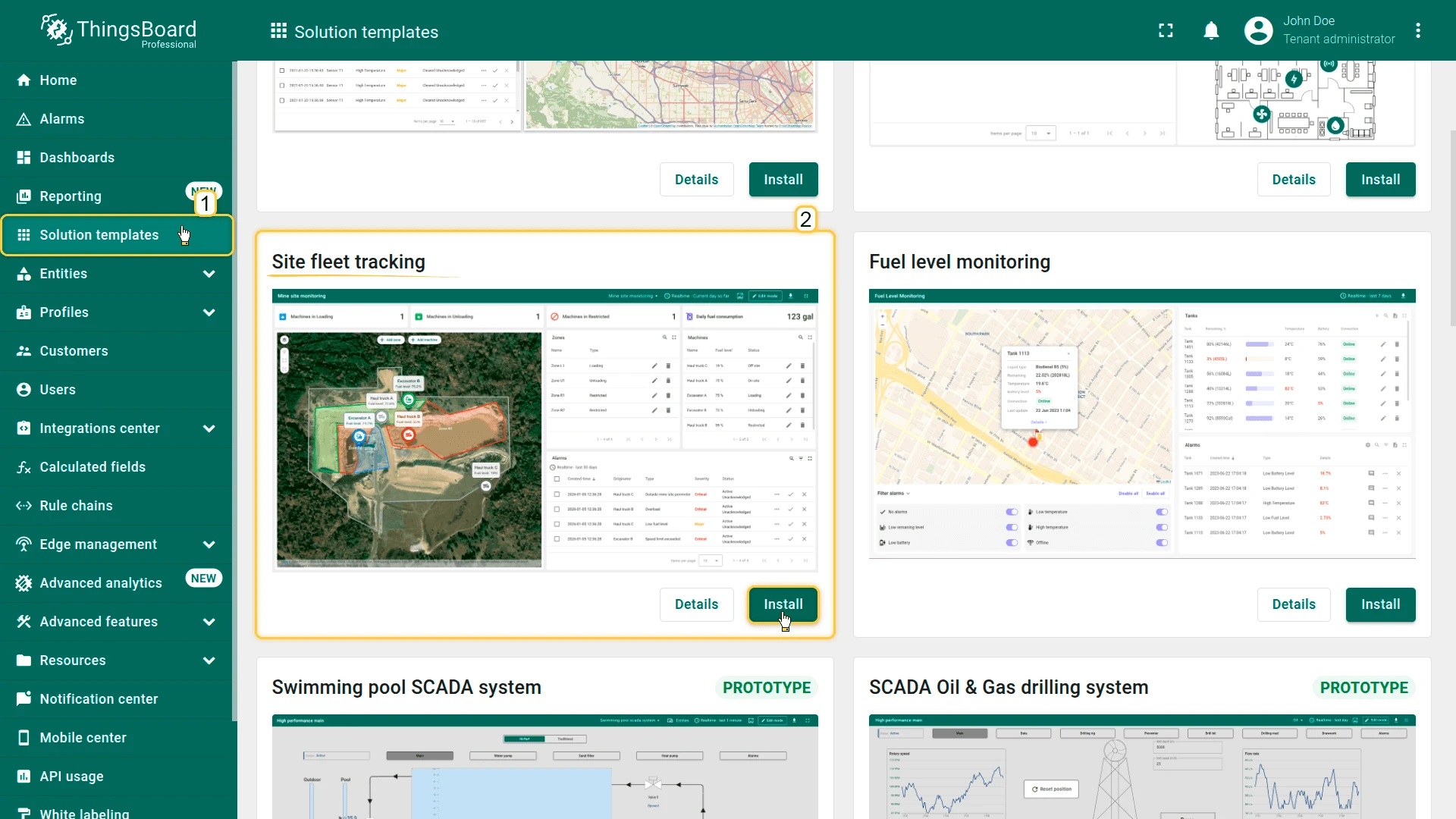
- Go to Solution templates in the main menu.
- Find Site fleet tracking and click Install.
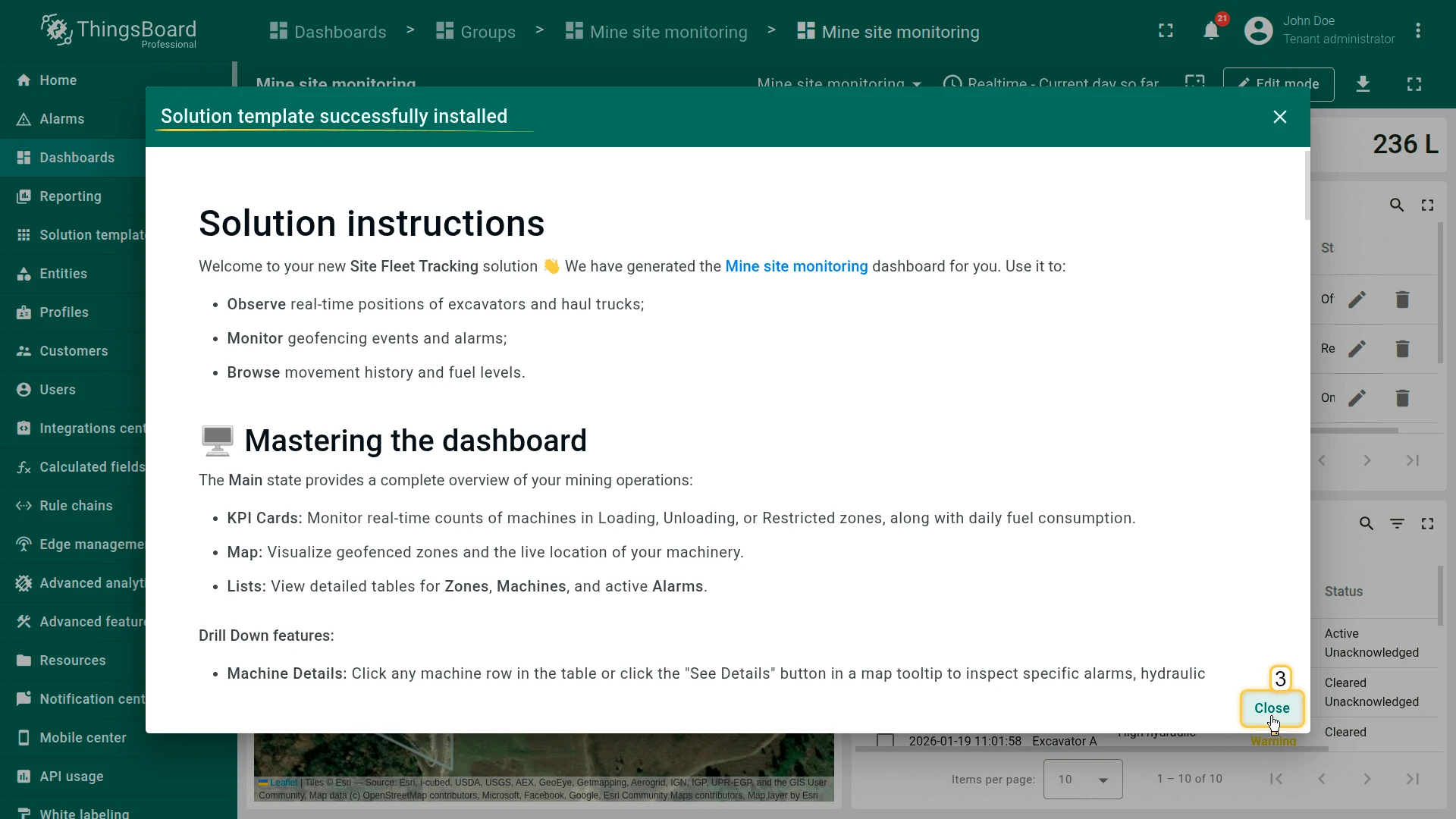
- Follow the provided configuration instructions and click Close.
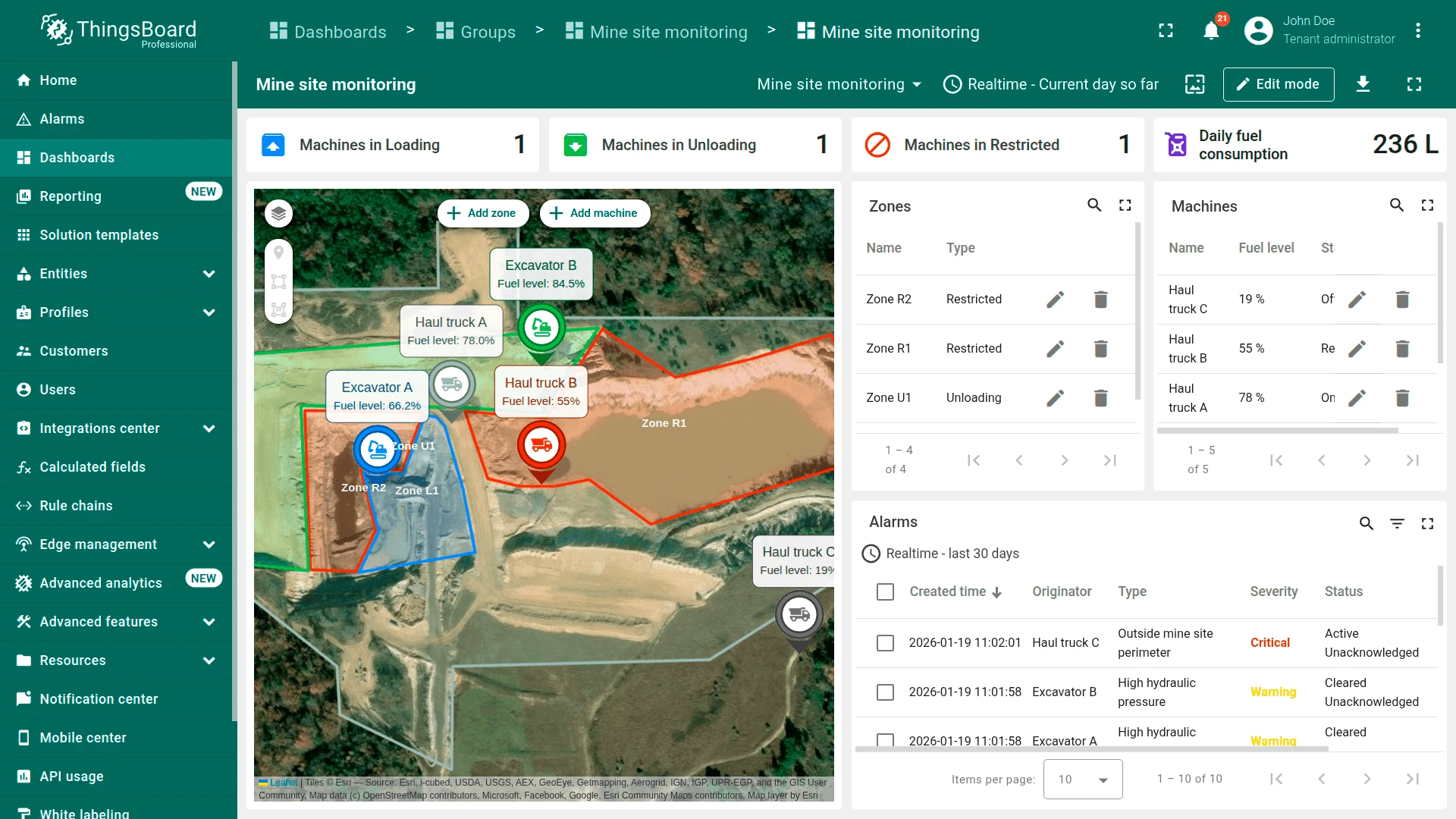
- The Mine site monitoring dashboard opens automatically.
After installation, a fully functional clay mine simulation is created automatically. No devices, integrations, or custom code are required to start exploring the solution.
System components
Section titled “System components”The Site fleet tracking solution includes:
- Dashboard: The Mine site monitoring dashboard provides real-time visualization of fleet activity, zone utilization, fuel consumption, and safety events
- Devices: Five pre-provisioned demo devices (two excavators and three haul trucks) that simulate real-world telemetry such as location, speed, fuel level, load weight, and hydraulic pressure
- Assets: A mine site asset with multiple operational zones, including Loading, Unloading, and Restricted areas
- Device profiles: Dedicated device profiles for excavators and haul trucks with calculated fields for geofencing and fuel consumption tracking, and pre-configured alarm rules for safety and operational monitoring
Dashboard
Section titled “Dashboard”The Mine site monitoring dashboard serves as the central control interface for monitoring fleet activity, zone utilization, fuel consumption, and safety events in real time.
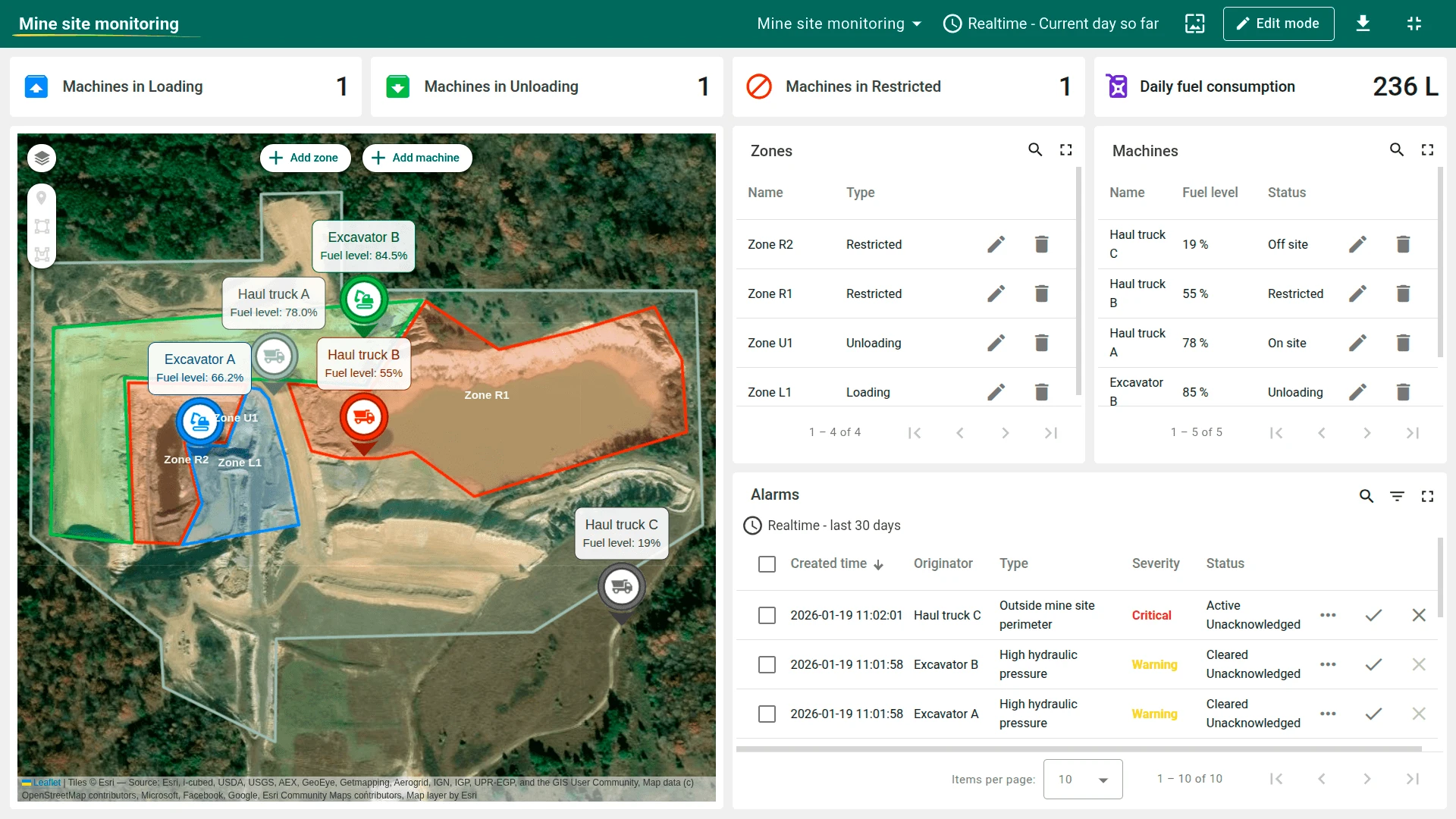
You can use the dashboard to:
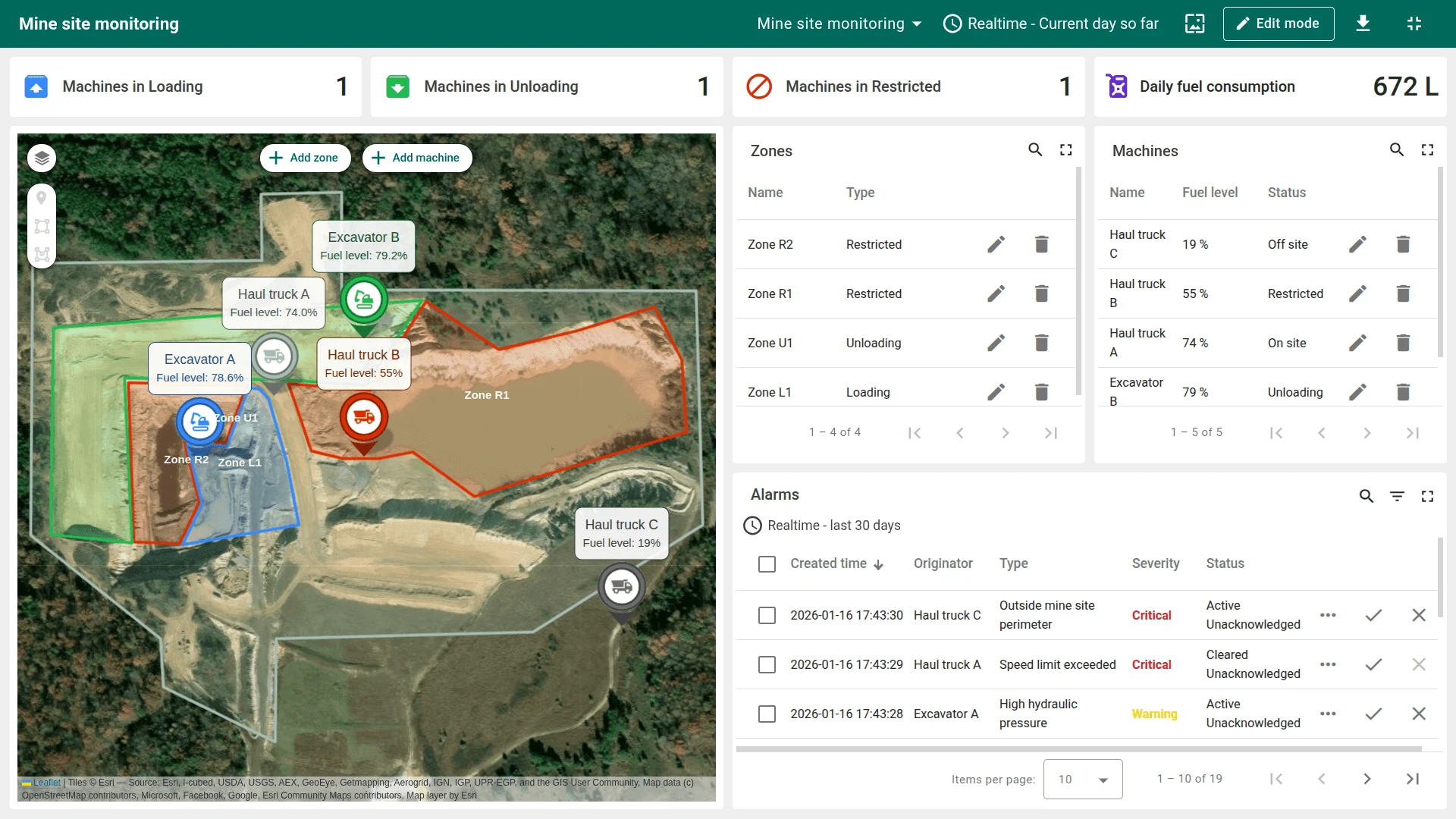
- View live machine positions on the map with KPI cards for machines in Loading, Unloading, and Restricted zones
- Monitor daily fuel consumption
- Drill down into machine details for telemetry history, alarms, and calculated metrics
- View zone details to see which machines are currently located inside each zone
- Drag and drop machine markers on the map to simulate location changes in real time
Dashboard states
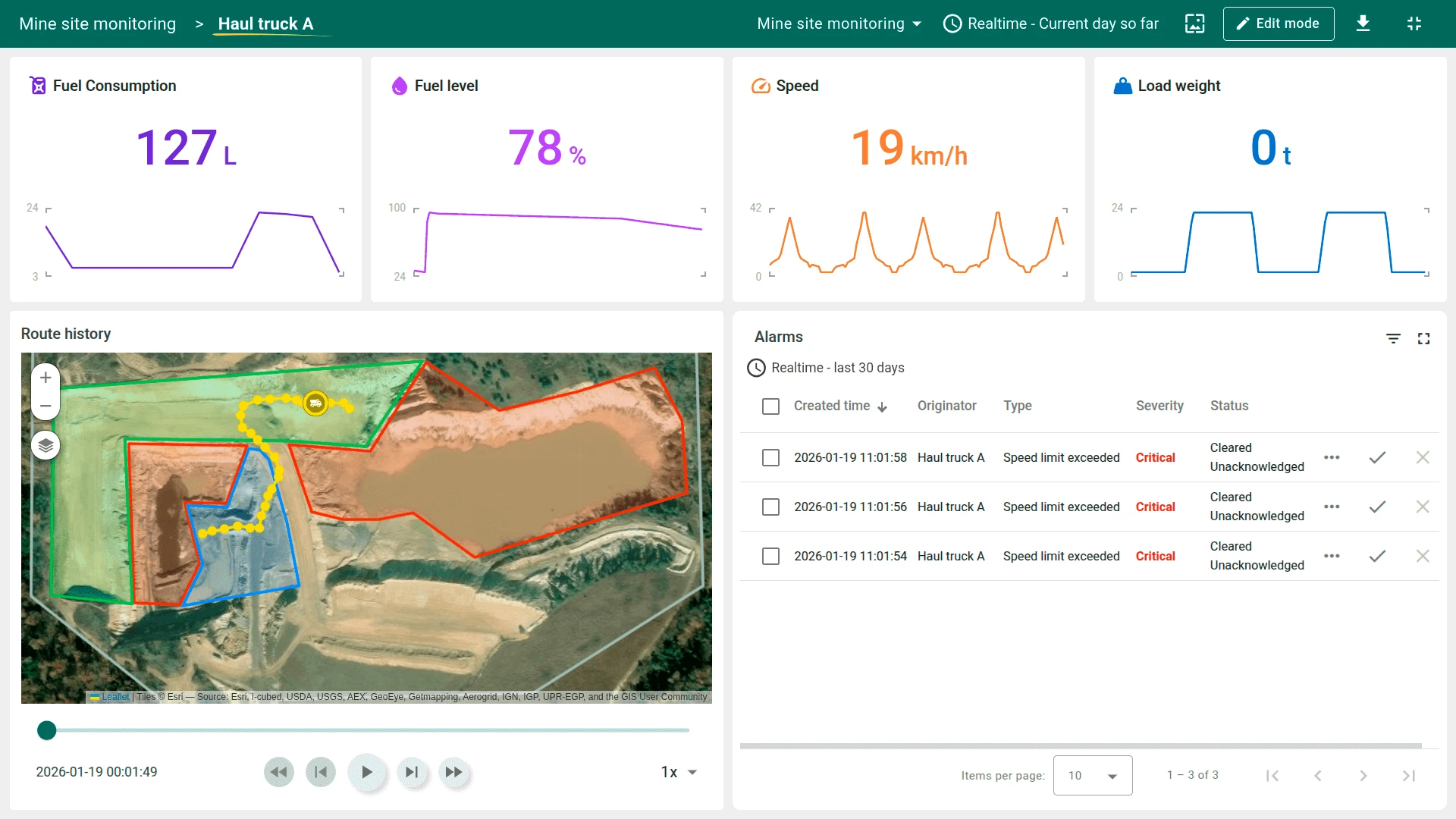
Section titled “Dashboard states”The dashboard consists of three states:
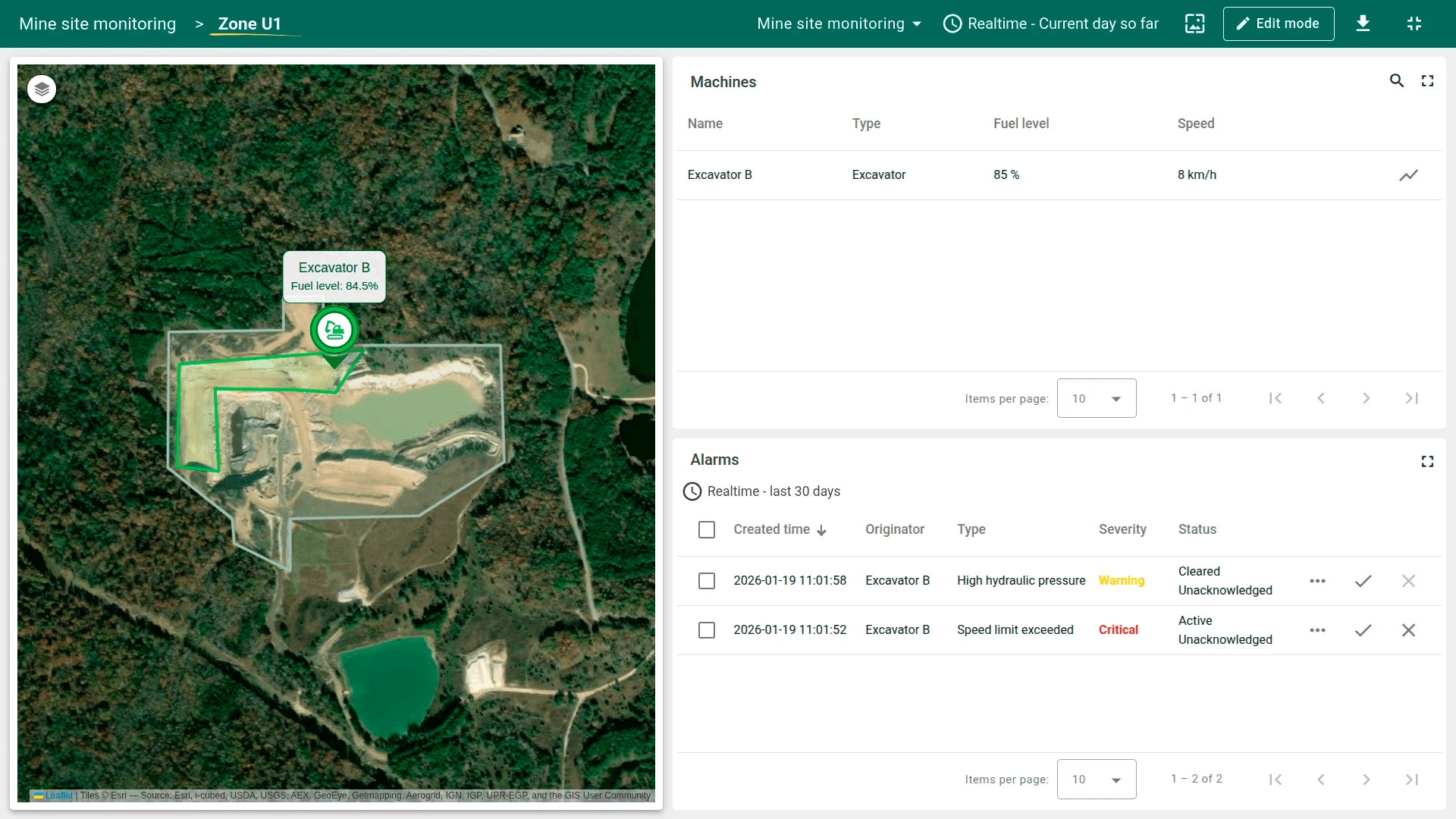
- Main state: Provides an overview of the entire site, including live machine positions on the map, KPI cards, and daily fuel consumption
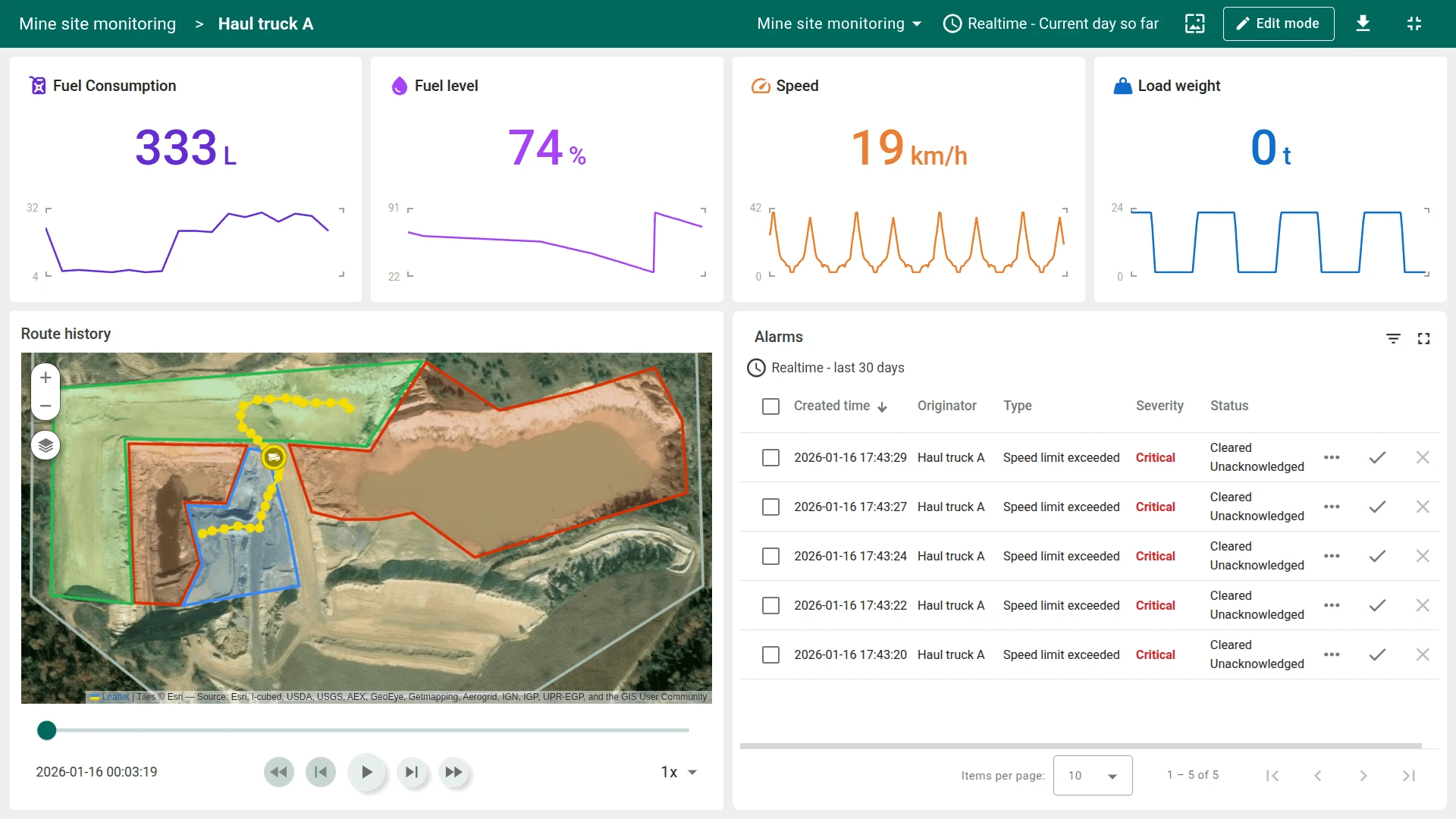
- Vehicle state: Displays detailed information about the selected excavator or haul truck, including fuel level, speed, hydraulic pressure or load weight, and active alarms
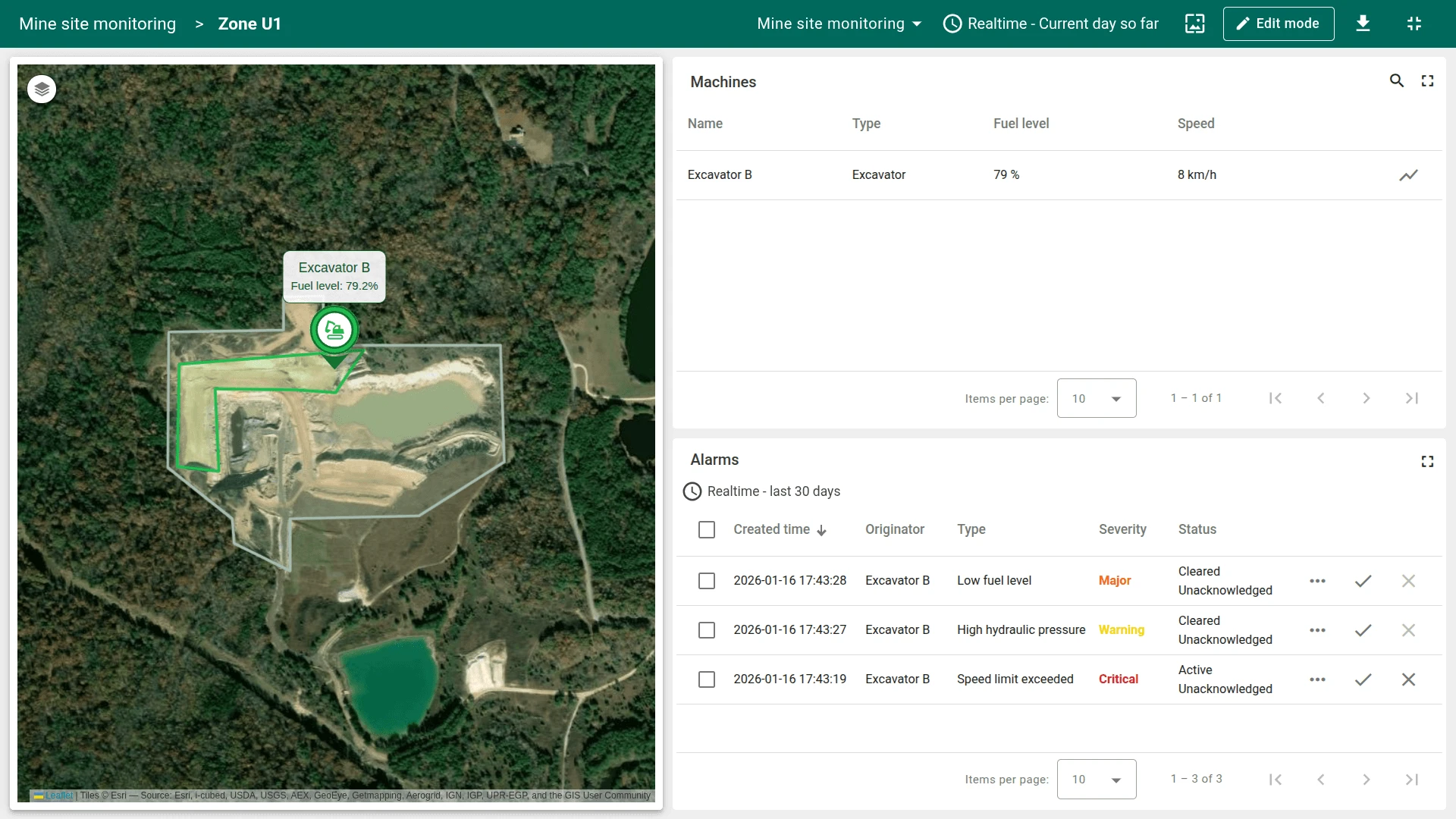
- Zone state: Shows the selected zone and the machines currently located within it
The dashboard can be fully customized using the dashboard development tools.
Devices
Section titled “Devices”Five demo devices are created automatically:
- Excavator A
- Excavator B
- Haul truck A
- Haul truck B
- Haul truck C
The solution expects devices to publish telemetry data in JSON format using the following keys:
{ "latitude": 36.215322, "longitude": -88.665637, "speed": 18.5, "fuelLevel": 72.3, "loadWeight": 56000}Haul trucks report loadWeight, while excavators report hydraulicPressure instead.
Replace $ACCESS_TOKEN with the actual access token of the device you want to send data to:
curl -v -X POST \-d '{"latitude": 36.215322, "longitude": -88.665637, "speed": 18.5, "fuelLevel": 72.3, "loadWeight": 56000}' \http://THINGSBOARD_HOST_NAME/api/v1/$ACCESS_TOKEN/telemetry \--header "Content-Type:application/json"The example uses the HTTP API. Other connectivity options (MQTT, CoAP, LwM2M, etc.) are supported as well. See connecting devices for details.
Alarms
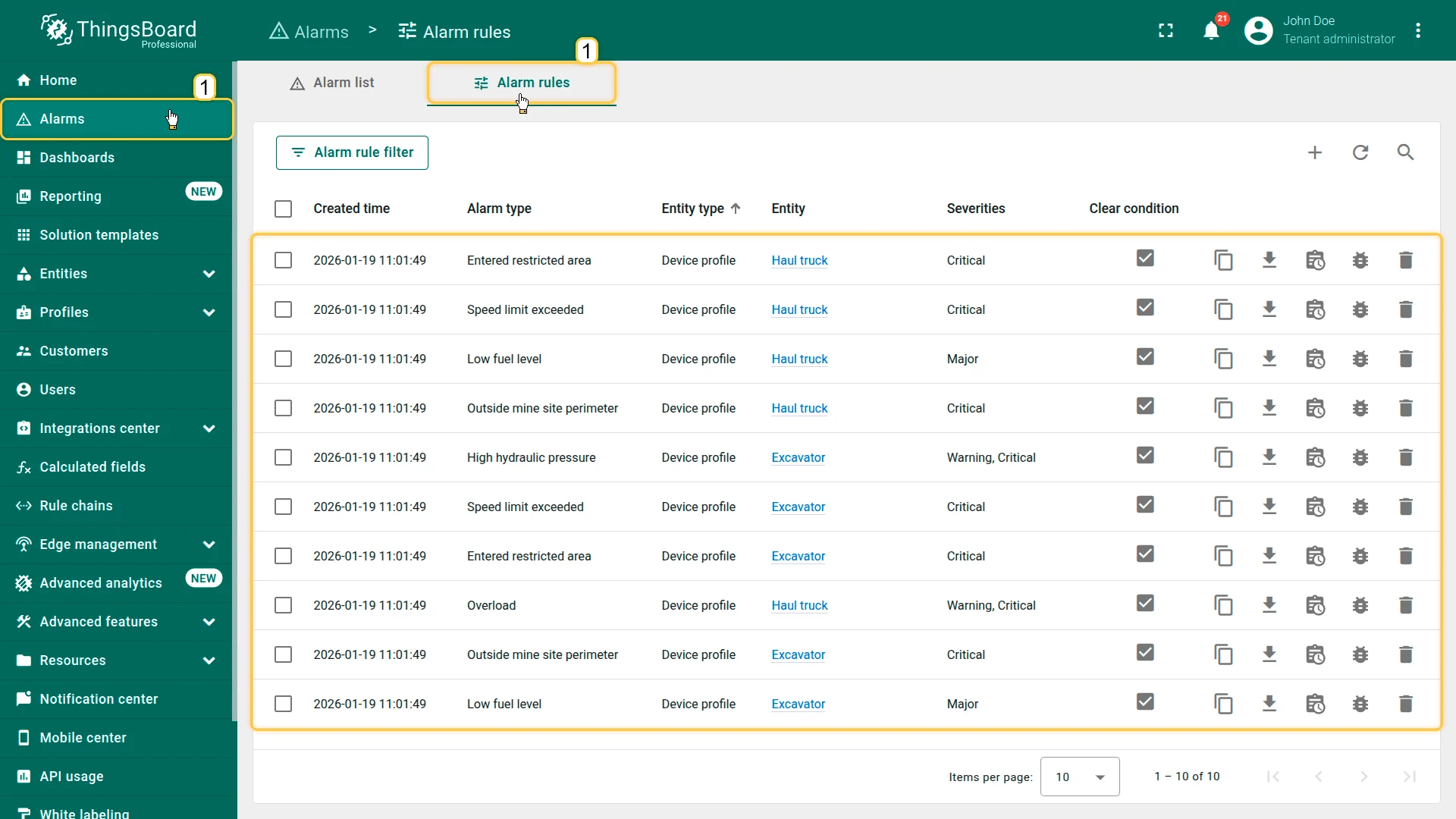
Section titled “Alarms”Alarm generation is handled by alarm rules configured in the Excavator and Haul truck device profiles. The solution monitors safety and operational conditions like restricted zone entry, speed limit violations, overloads, high hydraulic pressure, low fuel, and mine site perimeter breaches.
Calculated fields
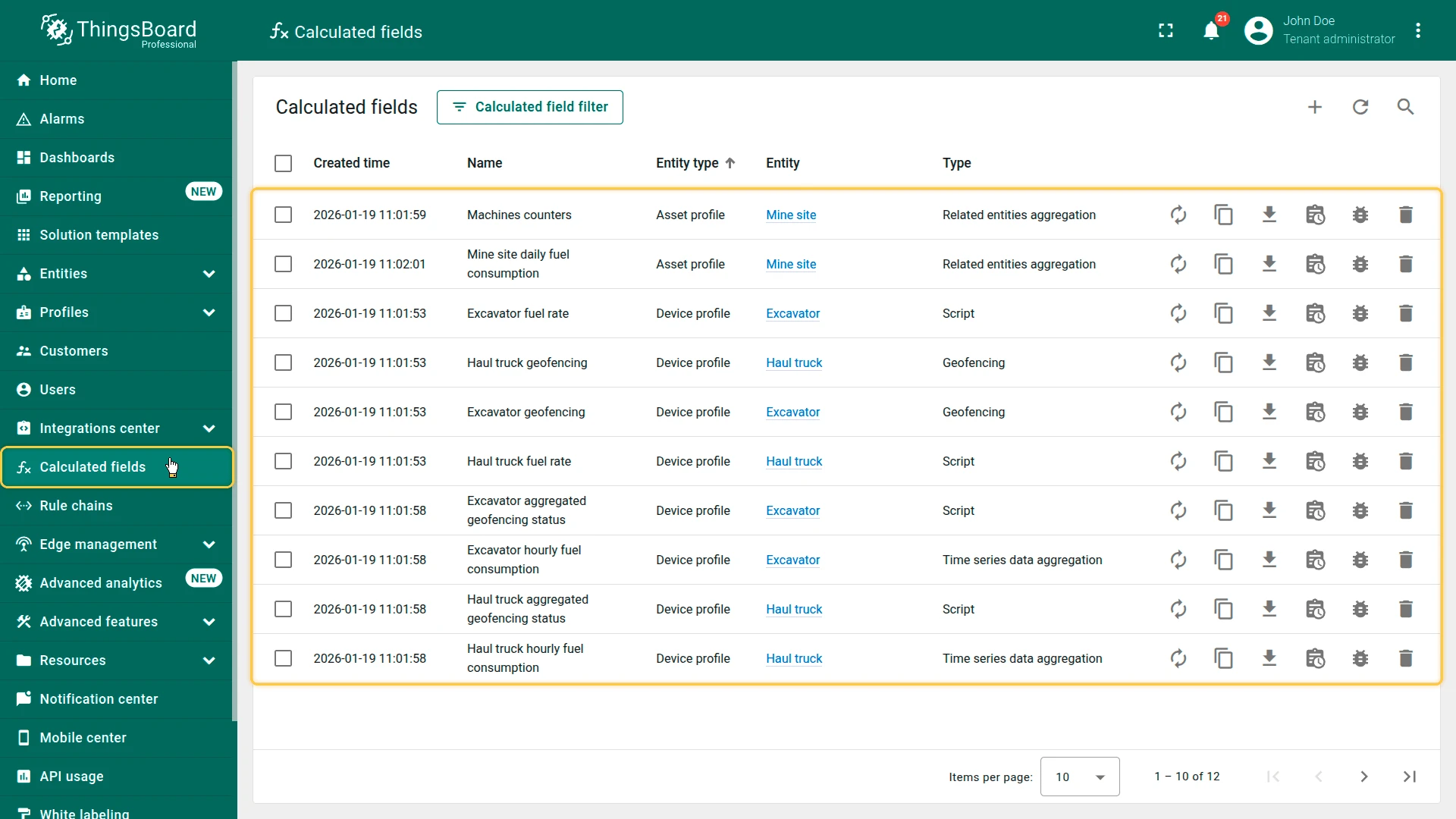
Section titled “Calculated fields”The solution uses calculated fields to derive geofencing events, fuel metrics, and fleet-wide aggregations from incoming telemetry. Calculated fields are configured in the Excavator and Haul truck device profiles and in the Mine site asset profile.
Geofencing
Section titled “Geofencing”Each device profile includes a geofencing calculated field that monitors four zone groups: Loading area, Unloading area, Restricted area, and Mine site perimeter. The geofencing configuration uses dynamic relations with matched zones to automatically track which device is located in which zone and display this on the zone states of the dashboard.
An aggregated geofencing status script consolidates zone events into a single geoStatus value per device, used by the dashboard to display zone-specific KPI cards and filter machines by location.
Fuel consumption
Section titled “Fuel consumption”A script calculated field computes fuelConsumptionRate from rolling fuelLevel telemetry data. It calculates the delta between consecutive readings and converts it to gallons based on the tank capacity.
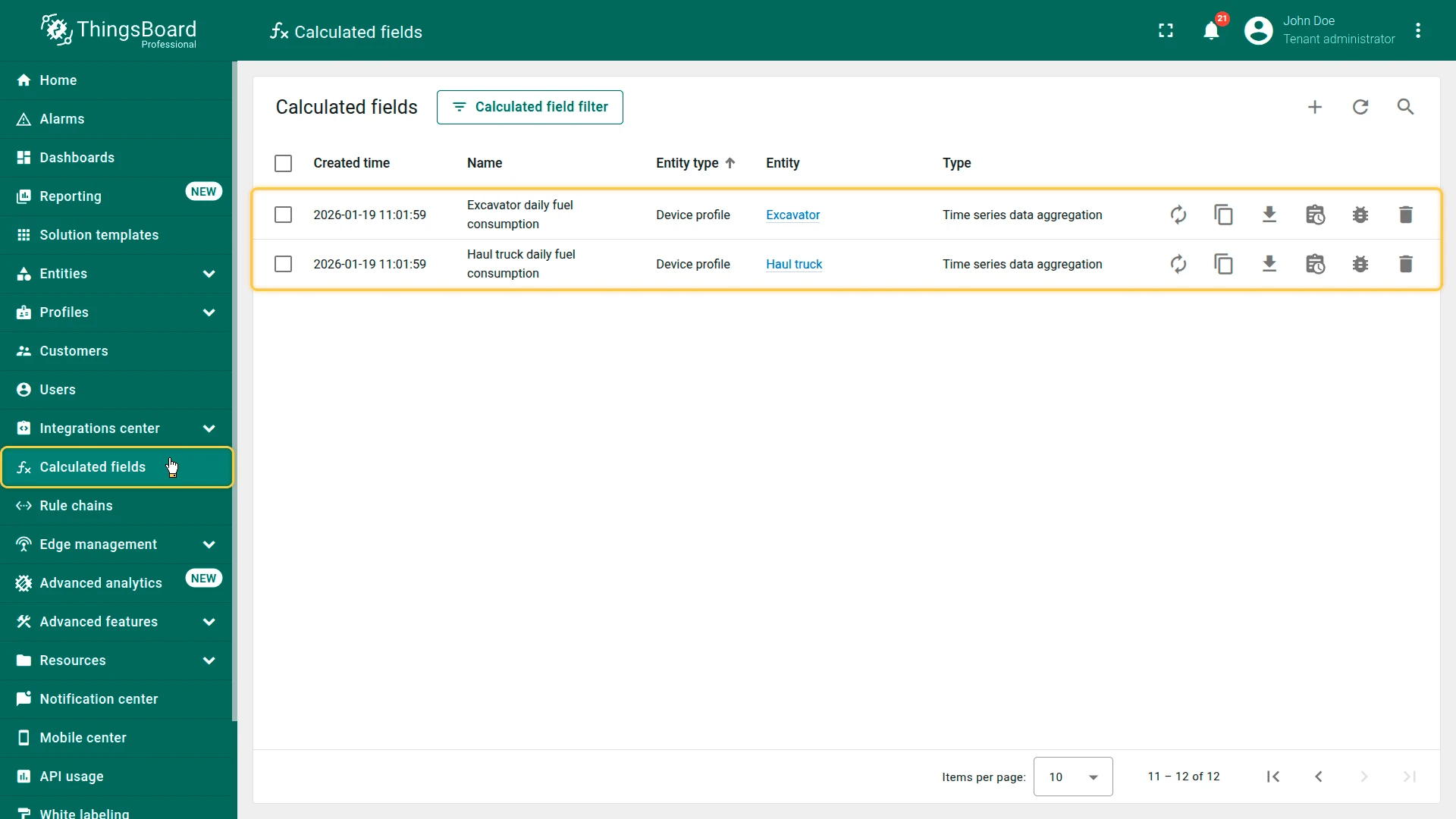
Entity aggregation calculated fields then compute hourly and daily fuel consumption per device. At the mine site level, a related entities aggregation field sums daily fuel consumption across the entire fleet.
Fleet counters
Section titled “Fleet counters”The Mine site asset profile includes a related entities aggregation calculated field (“Machines counters”) that counts machines in each zone (Loading, Unloading, Restricted) based on their geoStatus. These counters drive the KPI cards on the main dashboard state.
Conclusion
Section titled “Conclusion”The Site fleet tracking solution template delivers a complete digital twin for heavy-industry fleet monitoring. By combining real-time location tracking, geofencing, calculated metrics, and alarm-driven safety logic, the solution enables operators to monitor site activity, improve safety, and optimize fleet utilization from a single dashboard.
Was this helpful?